Bonjour mes amis 🌸
Do you ever hesitate before saying “I miss you” in French? The verb “manquer” has a special structure that can feel quite backwards for English speakers.
💔 Why “manquer” Feels Tricky
In English, when you miss someone, YOU are doing the missing: “I miss you.” Simple, right? The subject (I) is the one experiencing the feeling.
But in French? Everything flips. When you want to say “I miss you,” you say: “Tu me manques“ – which literally translates to “You are missing to me.” 🤯
Wait, what?! The person you’re missing becomes the subject, and you become the object. It’s like the sentence is inside-out!
Your brain wants to say “Je te manque” (I miss you – literally “I am missing to you”), but that actually means “You miss me” in French. It’s backwards! 😵
Here’s where it gets even more confusing: manquer doesn’t always work this way.
When you’re talking about nostalgia or missing a thing (not a person), the structure is more straightforward:
- La France me manque = France is missing to me = I miss France ✓
- Mon pays me manque = My country is missing to me = I miss my country ✓
And when you miss a train or an opportunity, it’s different again:
- J’ai manqué le train = I missed the train ✓
- J’ai manqué l’occasion = I missed the opportunity ✓

Here’s the thing: You can’t logic your way into using “tu me manques” naturally.
You can understand the grammar explanation perfectly and still freeze every time you try to say it. That’s because knowing a rule consciously is very different from being able to use it automatically in conversation. 🧠
What you actually need is to hear “tu me manques” used repeatedly in a meaningful, emotional context – a context where your brain connects the structure to real human feelings. That’s how it becomes automatic.
That’s how acquisition happens.
A touching story that is going to help you 🪨🌳
I want you to watch something compelling.
It’s a story called “Le Caillou et l’Arbre“ (The Stone and the Tree) – and it’s going to change how you understand “tu me manques“.
The story is about a stone (un caillou) who lives near a hazelnut tree (un noisetier – there’s your new French word! 🌰). At first, the stone doesn’t appreciate the tree. He finds it annoying. But then… something changes. And by the end of the story, the stone realizes how much he misses the tree. 🪨💔🌳
Throughout this touching tale, you’ll hear “tu me manques“ used again and again in deeply emotional contexts. You won’t be analyzing grammar. You’ll be absorbed in the story – feeling what the stone feels, understanding his loneliness, his regret, his longing.
And meanwhile, something magical is happening in your brain: the structure “tu me manques” is being absorbed unconsciously. Your brain is recognizing the pattern, connecting it to emotion and meaning, making it familiar and automatic. 🧠✨
This is the power of Story Listening. When you encounter a complex structure embedded in a compelling story – not isolated in a grammar exercise, not explained with charts, but woven naturally into a narrative that moves you – your brain acquires it without effort.
And in the future? You won’t have to think hard before saying “tu me manques.” It will come spontaneously out of your mouth, naturally, the way native speakers use it – because your brain has internalized the pattern through meaningful exposure. 🇫🇷💫
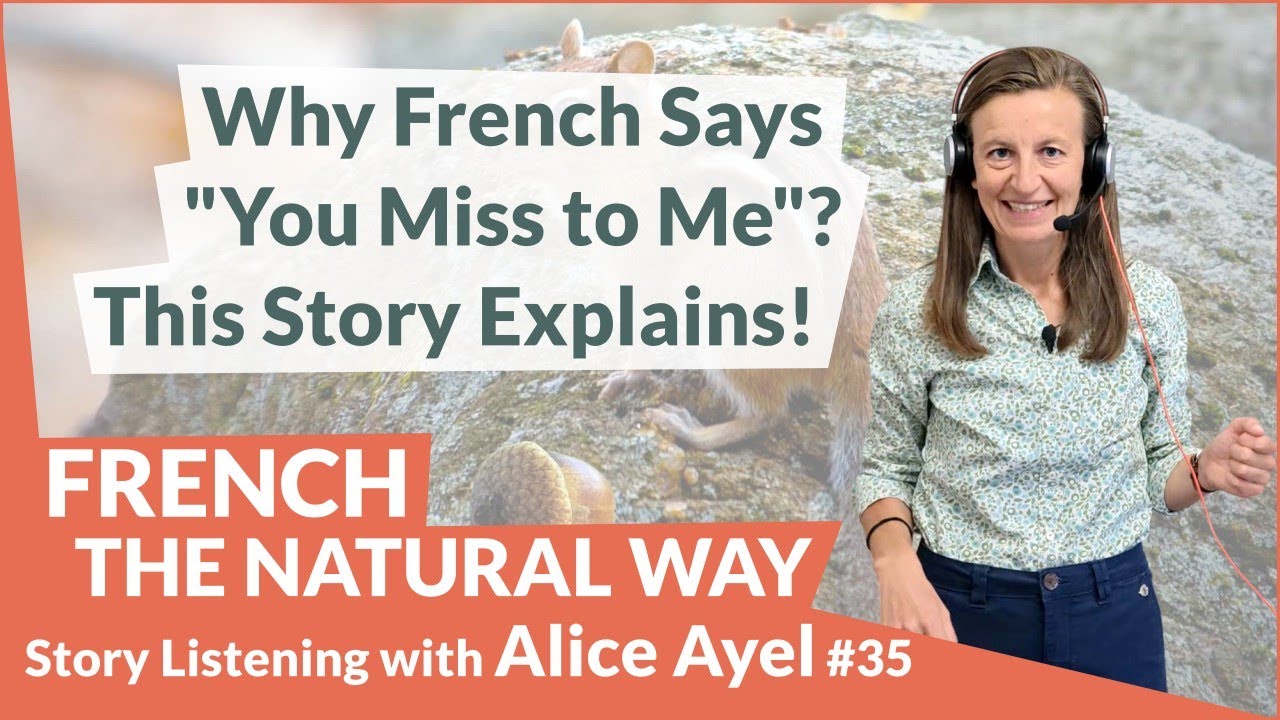
👉 Watch the story here: https://youtu.be/URhvadVt1Xg
What Our Community Is Saying 💬✨
After watching the video, one of our members, @Daglato, shared this great reflection:
“Merci pour cette histoire et pour la leçon sur « tu me manques ». En tant que locuteur anglophone, j’ai eu du mal à m’habituer à l’idée de mettre le mot « te » avant le mot « me ».”
(Translation: “Thank you for this story and for the lesson on ‘tu me manques.’ As an English speaker, I struggled to get used to the idea of putting the word ‘te’ before the word ‘me.'”)
Do you see what @Daglato is describing? That struggle with the word order – putting “te” before “me” – that’s exactly what trips up English speakers! But through this story, that structure is becoming familiar, natural, automatic. That’s acquisition in action. 🌟
Now here’s something powerful you can do to deepen your understanding even more:

👉 Read the story again on our site: https://www.aliceayel.com/resources/le-caillou-et-larbre/
And then, copy the passage from the story where you see “tu me manques!“
Yes, physically write it out by hand (or type it). Copy the sentence. Copy the context around it. Copy the moment in the story where those words appear. ✍️
Why is copying so powerful?
✨ It slows you down – You’re not skimming. You’re paying attention to every word, every structure.
✨ It engages your motor memory – The physical act of writing helps your brain encode the pattern more deeply.
✨ It connects structure to meaning – You’re not copying random sentences from a textbook. You’re copying a moment that matters in the story, which makes it memorable.
✨ It makes the language yours – When you write it yourself, you’re not just reading someone else’s words. You’re actively engaging with French, making it part of your own expression.
This simple practice – reading, then copying a meaningful passage – is one of the most effective ways to move language from passive understanding to active internalization.
Try it! You’ll be surprised by how much it helps. 📖
Ready to Make Real Progress in French? 🇫🇷✨
Imagine having access to hundreds more compelling stories just like it – all carefully chosen to help you acquire French naturally, one beautiful tale at a time. 🌟
To access all our stories, join our French program. Inside, you’ll be able to watch, read, and listen to stories organized by level – from complete beginner to advanced.
No overwhelm. No confusion. Just clear, joyful progress. 📚💙
One story at a time, your French is growing. And before you know it, those “backwards” structures won’t feel backwards anymore. They’ll just feel… French. 🇫🇷✨
👉 Join us here: https://www.aliceayel.com/
The stories are waiting. Your French-speaking self is closer than you think.
À bientôt!
Alice 🌷
P.S. After you watch the stone and tree story, come back and tell me – did it make you feel something? The best language learning happens when stories touch our hearts. I’d love to hear what you thought! 💬