Bonjour mes amis 🌷
The “To Know” Problem That Haunts French Learners 😫
You’re in the middle of a conversation (or trying to write something in French), and you need to say “I know.” Simple enough in English, right? But in French, your brain suddenly hits the brakes. 🛑

Wait… is it “savoir” or “connaître”? Which one am I supposed to use here?
You’ve looked up the grammar rule more times than you can count. You understand it when you read the explanation: savoir is for facts and how to do things, connaître is for people and places. It makes sense… intellectually. 🤔
But the moment you actually need to USE it – in real conversation, in real time – your mind goes completely blank. You hesitate. You second-guess yourself. You might even avoid saying “I know” altogether because you just can’t remember which verb fits. 😓
Sound familiar?
Here’s what you need you to understand: You can’t think your way into using “connaître” (or “savoir“) correctly. No amount of studying the rule will make it automatic. Your brain simply can’t access conscious grammar rules fast enough during spontaneous communication. That’s why you keep freezing – you’re trying to recall and apply a rule in real-time, and it creates mental overload. 🧠💥
What you actually need is to hear these verbs used naturally, repeatedly, in contexts that make sense and engage your emotions. That’s how patterns become automatic.
That’s how acquisition happens. 💡
The Long-Term Solution: Let Stories Do the Teaching 🐰🐘✨
This week, I want to introduce you to an African tale that’s going to change how you understand “connaître“: “Le Lièvre et l’Éléphant“ (The Hare and the Elephant).
This isn’t a grammar lesson disguised as a story. It’s a compelling narrative about a clever hare and a powerful elephant – and as you listen, something magical happens. You’ll hear “connaître” used again and again in meaningful contexts.
Not in isolated sentences. Not in fill-in-the-blank exercises. But woven naturally into a story that makes you curious: What’s going to happen next? 🤔💫
Your brain will absorb the pattern without stress, without forced memorization, without that panicky feeling of “am I doing this right?”
You’ll just be enjoying the story – and meanwhile, your brain is doing the deep work of acquisition. Building connections. Recognizing patterns. Making “connaître” automatic. 🧠✨
This is the power of Story Listening. No grammar charts to memorize. No rules to recall under pressure.
Just natural acquisition – the same way you learned your first language as a child, by hearing it used meaningfully around you. 🌟
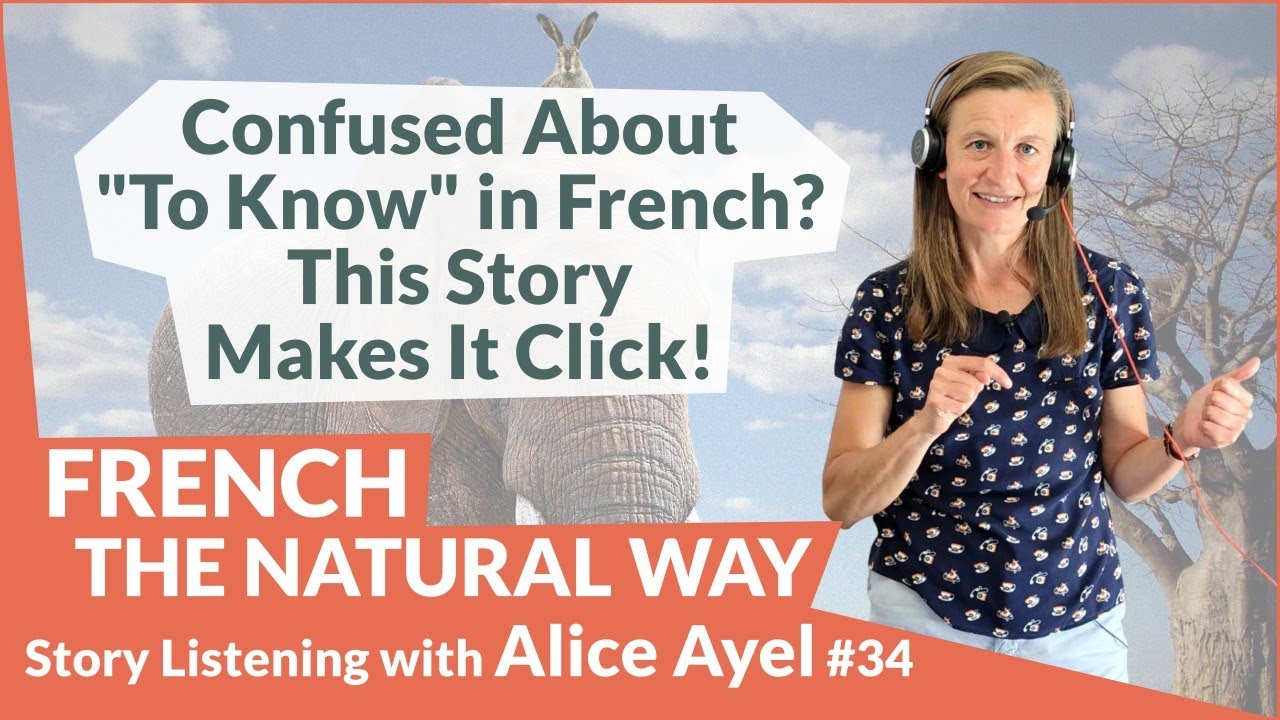
👉 Watch the story here: https://youtu.be/6QcrHgHFbPU
A Little Game to Show You What You’ve Acquired 🎯
After you watch the video, I want you to try something fun. Don’t go back and rewatch it – just see if you can answer these three simple yes/no questions about the hare and the elephant:
- Est-ce que le lièvre connaît un secret ?
- Est-ce que l’éléphant veut connaître le secret du lièvre ?
- Est-ce que le lièvre dit le secret à l’éléphant ?
Take a moment. Think about the story. You probably understood those questions, didn’t you? Even with “connaître” right there in the sentence! 🎉
Let me translate them for you:
- Does the hare know a secret? → Oui, le lièvre connaît un secret. (Yes, the hare knows a secret.)
- Does the elephant want to know the hare’s secret? → Oui, l’éléphant veut connaître le secret du lièvre. (Yes, the elephant wants to know the hare’s secret.)
- Does the hare tell the secret to the elephant? → Non, le lièvre ne dit pas le secret à l’éléphant. (No, the hare doesn’t tell the secret to the elephant.)
See what just happened? You just read and understood sentences with “connaître” – the very verb that felt confusing before! And you probably didn’t even notice it was there because you were focused on the story, not the grammar. That’s acquisition in action. 💫✨
Your brain is already starting to recognize the pattern. Not because you memorized a rule, but because you experienced it in a meaningful context. That’s how language sticks. 🧠
Go Deeper: Read and Listen Again 📚🎧
Now that you’ve watched the video and your brain has started absorbing the pattern, I encourage you to read and listen to the story again on our site:

👉 https://www.aliceayel.com/resources/le-lievre-et-lelephant/
Reading while listening deepens your comprehension. You’ll notice details you missed the first time. The language will settle more deeply into your mind.
And “connaître“? It’ll start feeling natural instead of confusing – like a friend you’re getting to know better.
No overwhelm. No confusion. Just clear, joyful progress, one beautiful story at a time. 🌟
This is how YOU can finally move past that freezing moment and actually USE French with confidence. 🇫🇷✨
Ready to make real progress in French?
👉 Join us here: https://www.aliceayel.com/

The journey is beautiful. The stories are waiting. And your French-speaking self? Closer than you think.
À bientôt!
Alice 🌷
P.S. After you watch the hare and elephant story, come back and tell me – were you surprised by what the hare did? I’d love to hear your thoughts! 💬🐰🐘