Bonjour mes amis 🌷
The Pronoun Problem That Drives French Learners Crazy 😫
Let me guess what’s been tripping you up in French…
You’re speaking or writing, and you keep repeating the same word over and over: “J’ai vu le chien. Le chien était grand. Le chien courait…” You KNOW there’s a way to say “it” or avoid all that repetition, but direct object pronouns like “le,” “la,” “l‘” feel completely confusing. 🤔
When do you use them? Where do they go in the sentence? Before the verb? After? And wait – sometimes it’s “le” and sometimes it’s “l’” – how are you supposed to remember all these rules?!

Here’s what usually happens: You look up the grammar rule. You read an explanation that kind of makes sense. Maybe you even do some fill-in-the-blank exercises and get most of them right. You think, “Okay, I’ve got this!” ✅
But then… when you’re actually trying to speak or write French? Your mind goes blank. The rule evaporates. You freeze. And you end up just repeating the noun again because at least that works, even if it sounds awkward. 😔
Here’s the truth: There’s a massive difference between knowing a grammar rule consciously and being able to USE the language naturally.
Fill-in-the-blank exercises give you knowledge about French. But they don’t give you French itself.
Your brain can’t access conscious grammar rules quickly enough during real communication. That’s why you freeze – you’re trying to think your way through something that needs to be automatic.

Instead, listen to compelling stories where those pronouns appear naturally, repeatedly, in meaningful contexts.
When your brain hears “l’” used again and again in a story that makes sense, it starts recognizing the pattern unconsciously. No memorization needed. No rules to recall.
Just natural acquisition, the way you learned your first language. 🧠✨
A True Story That Will Change How You Use French Pronouns 🦁🐕
I want you to watch something. It’s a true story written by the famous Russian writer Léon Tolstoï about something extraordinary that happened at a zoo: A dog was thrown into a lion’s cage.
What happened next will move you. And without even trying, without studying a single grammar rule, you’ll start understanding how to use that little pronoun “l’” to avoid repeating the same noun over and over.
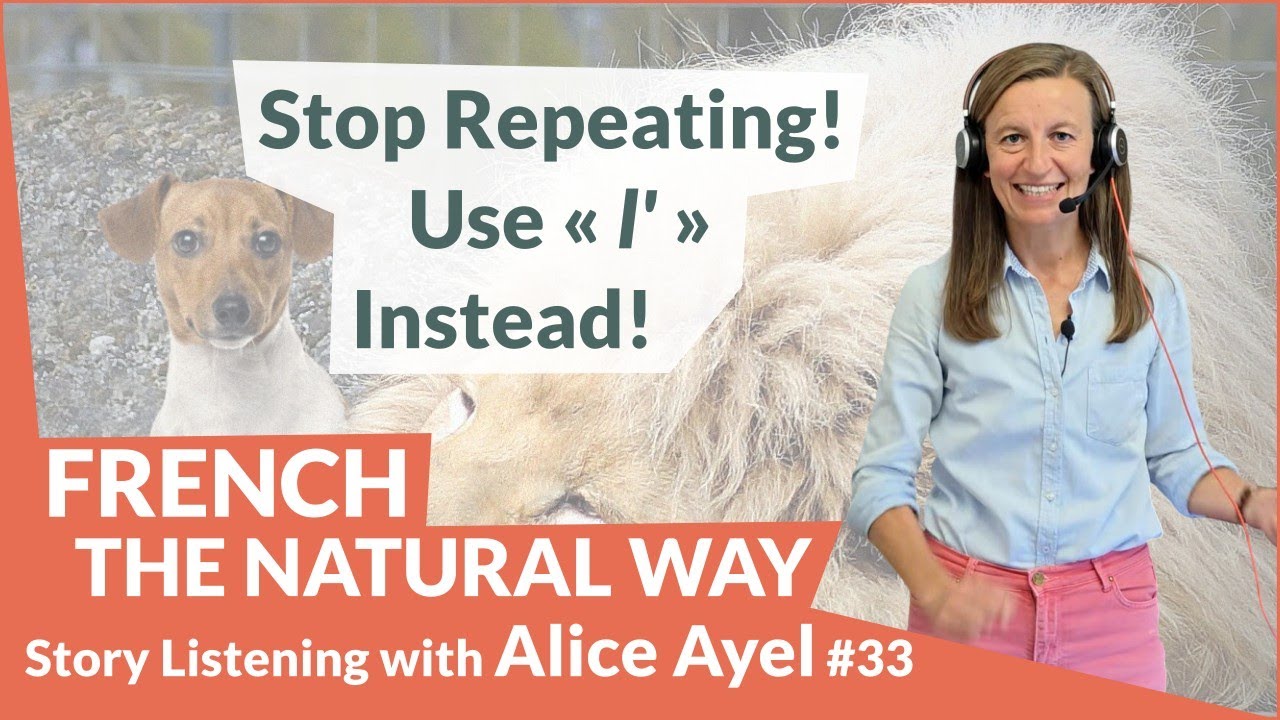
👉 Watch the story here: https://youtu.be/nCPBy3lRBp0
As you watch, don’t worry about grammar. Don’t try to analyze anything. Just focus on the story.
What happens to the dog? What does the lion do? Let yourself be absorbed in this beautiful, surprising tale. 📖✨
This is how acquisition happens – not through effort, but through engagement. Your brain is working even when you’re just… enjoying a good story. 🌟
A Little Game to Show You What You’ve Already Learned 🎯
After you’ve watched the video, I want you to try something. Without going back to rewatch it, see if you can answer these three simple yes/no questions about the lion and the dog:
- Est-ce que le lion a flairé le chien ? (Did the lion sniff the dog?)
- Est-ce que le lion l’a mangé ? (Did the lion eat it/him?)
- Est-ce que le lion l’a caressé ? (Did the lion caress it/him?)
Notice what just happened? You just read and understood sentences with “l'” – the very pronoun that felt confusing before!
And you probably didn’t even notice it was there because you were focused on the meaning, not the grammar. 🎉
Let me translate those questions for you:
- Did the lion sniff the dog? → Oui, le lion a flairé le chien. (Yes, the lion sniffed the dog.)
- Did the lion eat him? → Non, le lion ne l’a pas mangé. (No, the lion didn’t eat him.)
- Did the lion caress him? → Oui, le lion l’a caressé. (Yes, the lion caressed him.)
See how “l'” replaces “le chien” (the dog)? Your brain is already starting to recognize that pattern. Not because you memorized a rule, but because you experienced it in a meaningful story. That’s the power of comprehensible input. 💫
Want to Go Deeper? Read and Listen Again 📚🎧
Now that you’ve watched the video and your brain has started absorbing the pattern, I encourage you to read and listen to the story again on our site:

👉 https://www.aliceayel.com/resources/le-lion-et-le-chien/
Reading while listening deepens your comprehension. You’ll notice things you missed the first time. The language will settle more deeply into your brain. And that pronoun “l’“? It’ll start feeling natural instead of confusing. ✨
To access the full story script and hundreds more compelling stories like this one, join our French program.
Inside, you’ll be able to watch, read, and listen to stories carefully organized by level – so you always know exactly what to do next. No overwhelm. No confusion. Just clear progress, one beautiful story at a time. 🇫🇷

Ready to make real progress in French?
👉 Join us here: https://www.aliceayel.com/
The journey is beautiful. And you’re going to love where it takes you. 🌟
À bientôt,
Alice
P.S. After you watch the story, come back and tell me – were you surprised by what the lion did? I’d love to hear your thoughts! 💬✨