Storytelling: arranging to go out
I am using stories more and more often in my lessons as I believe my students greatly benefit from listening to them as well as reading them and writing new ones. Apart from inventing my own stories, my favorite source is The Comprehensible Classroom which has a wealth of fantastic resources and story scripts. Recently I have also used Martin Lapworth’s website who also posts many resources connected to TaskMagic (a software which allows you to create different exercises based on a text or a list of vocabulary). The short-story script I used from his site is “¿Quieres salir conmigo?“which is about asking someone to go out / arranging to go out, with lots of high frequency expressions such as:
(no) quiero / quieres / quiere + inf
(no) me / te / le gusta + inf
porque
así que
voy / va / van
está + feeling
es + description
conmigo / contigo / con él / ella
This fitted perfectly with the topic I covered with grade 7 (12-13 years old) about free time.
Listening: I first told the story to my students “TPRS style” (again I am not a trained TPRS teacher but I have read a lot about this concept lately!) with the help of my puppet fingers. I tried to do a lot of circling with the key structures so that students are not only listening but are also interacting. This way of “delivering” a story is greatly beneficial to students because they hear a lot of comprehensible input and they also repeat a lot of high frequency structures.
Reading: I then used Martin Lapworth’s worksheetsas a reading activity for my students to “internalize” the story. I didn’t use all of the worksheets but some of them such as the one where students have to put the segments of the story in the correct order or the one where you have to fill in the gaps.
Speaking Project: when I felt students were comfortable with using the key structures they needed to create their own stories, I set them on the “video project”. Students worked in groups of 2-3 and had to imagine a similar story, write the script and then film it using puppets or anything else they wanted to use. The “making” process took more lessons than expected but I believe it was worthwhile! Here are some videos which I posted on my YouTube account:
Different language projects around the topic of school
The topic of school in grade 6 (11-12 years old) gives the opportunity to learn about the facilities at a school, the different subjects and the time (here is the curriculum I planned for this topic). At the end of the topic I like to have a my students work on a project to recap all the new vocabulary and structures they have learned. In the past, my students had to record a radio interview where a radio presenter would ask questions to several students about their school: listen to ‘Una entrevista sobre una escuela.’ on Audioboo
Another fun project was to design a leaflet about an ideal school and then present it:
This year, I asked my students to design and present their ideal school in the middle of the topic, which means that my students had only learned about the vocabulary related to the different facilities in a school. I wanted them to use “hay..” and different connectives such as “también“, “tampoco“, “pero“… My students really enjoyed the designing process and they did a great job presenting their schools as it was their first oral presentation in Spanish. I did not record them this time but I took pictures of their creative school plans:
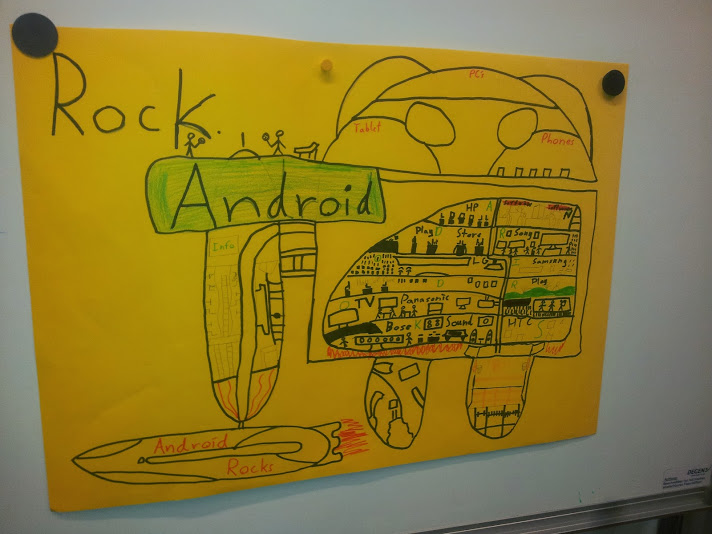
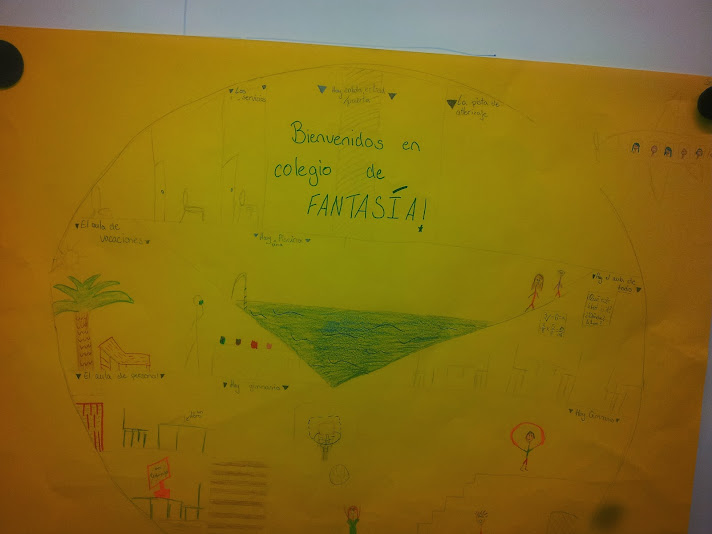
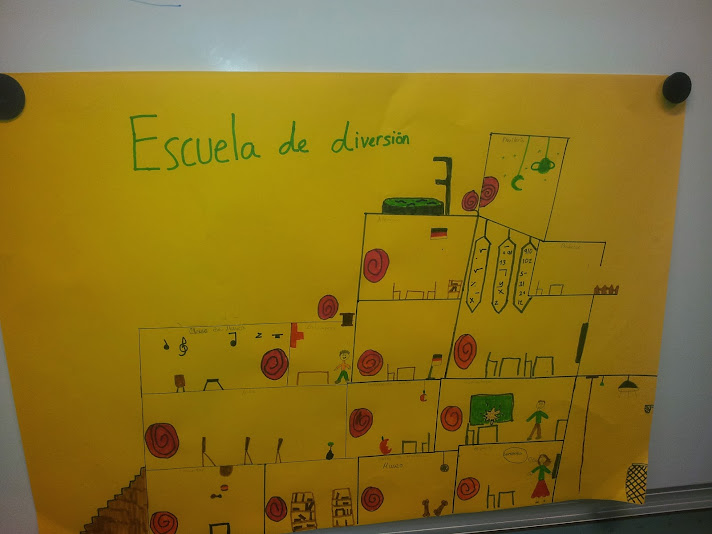

 After each presentation, the rest of the class had to feedback about the fluency of the speech as well as the use of varied vocabulary and structures and creativity. The feedback was very constructive as my students took note of the different connectives and structures used as well as how the words were pronounced. Overall, it was an engaging project with good peer-assessment.
What do the other students do when some are recording a podcast?
When some students are recording their IGCSE questions and answers to practice for the oral examination, I like to have the other students work in different stations so that nobody misses out during the lesson. The recording process is one station and I am lucky enough to have a spare room next to my classroom which is rarely used so that my students can record themselves in a quiet space. The first 10 minutes or so of the lesson are spent preparing the answers to the questions and when the recording process starts, each group goes to a station to work on a specific skill or topic. Here are some examples:
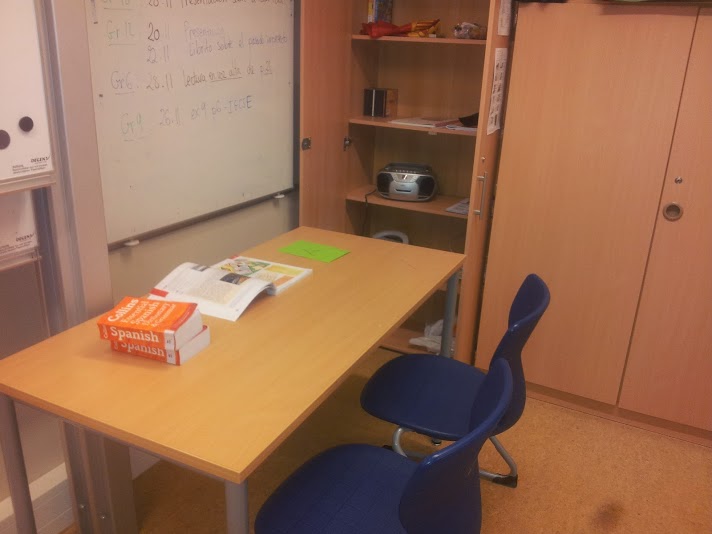 The listening station where students listen to a CD and answer some comprehension questions. On this picture, I used an exercise from their textbooks. Students can play and pause the CD according to their needs so it is less stressful than a “whole class” listening exercise.
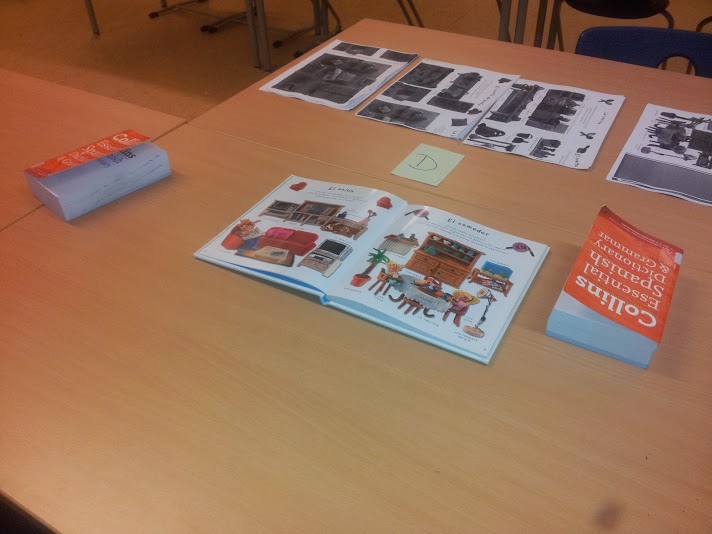 The vocabulary station where students memorize new words from a picture-vocabulary book or some worksheets. Students can test each other and work at their own pace.
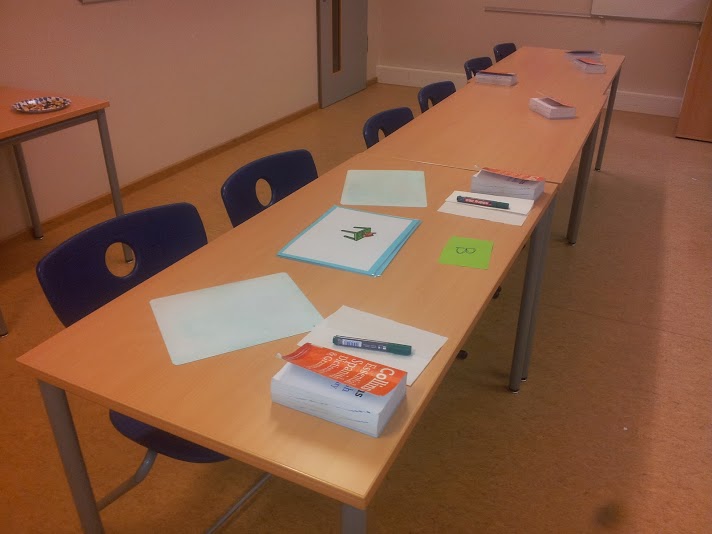 The flashcard station. In that case students were reviewing prepositions and were asking each other “where is the mouse?”; they could also use the small whiteboards to practice spelling.
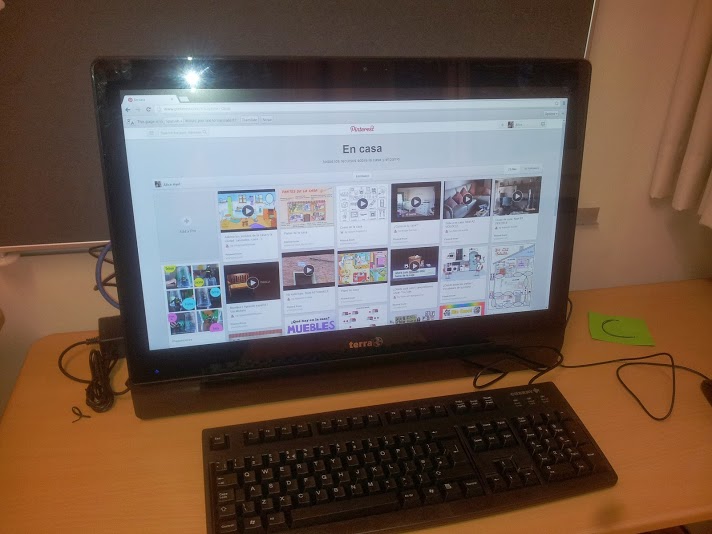 The computer station. I only have one computer in my classroom but it is perfect for station work. I usually get my students to browse the resources on my Pinterest boards.
I find station work does not involve much preparation and because students are working in small groups and at their own pace, I find that they are more productive and engaged. I can also get to help the ones who are struggling more efficiently. By the way, here is another board on Audioboo to review questions and answers about home town and local area:
Fun and simple idea to practice "gustar"
The verb “gustar” is not an easy verb to use as it is so different from “normal”verbs. The majority of students know how to use it in the first person singular “me gusta” but they rarely know how to use it when they want to refer to someone else. Hence the objective of my lesson with grade 6 (11-12 years old): to be able to say what other people like. This is how my lesson went:
Speaking : as a warm-up, we clapped our hands saying different activities. For example: ver/la/te/le/vi/síon, we clapped our hands 6 times while saying the sentence. We did it several times and I then clapped my hands without saying anything and students had to guess the activity. I then let students had a go and we played the game for a good five minutes. As the lesson was after lunch, this was the perfect way to get my students focused as they really had to concentrate and to listen carefully to the number of claps.
Reading : I then had my students work in pairs and match cards (activity/sentence with picture): ir a la playa, tocar la batería, leer comics, hacer los deberes, ir de compras, navegar por Internet….
Speaking/ Listening: Students then asked each other: ¿A tí, te gusta ir a la playa? / Sí/No a mí, (no) me gusta ……
I told them they had to really listen to the answers and try to memorize them for the next activity.
Writing: this time, my students had to write on the big white boards in my classroom, what one of their classmates like or doesn’t like to do. They could not mention any name but they should start with: A él/ella (no) le gusta….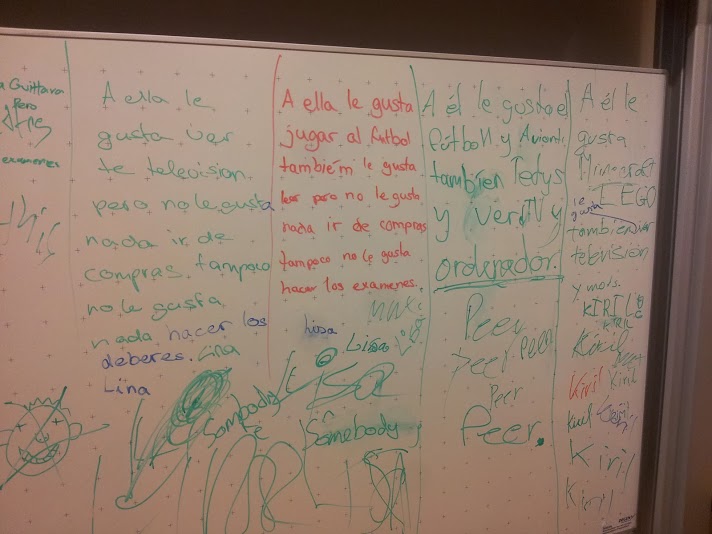
Reading: the final step was to read each paragraph on the board and to guess who the person was by writing a name next to the paragraph. My students could also correct a mistake if they spotted one (which some of them loved doing!).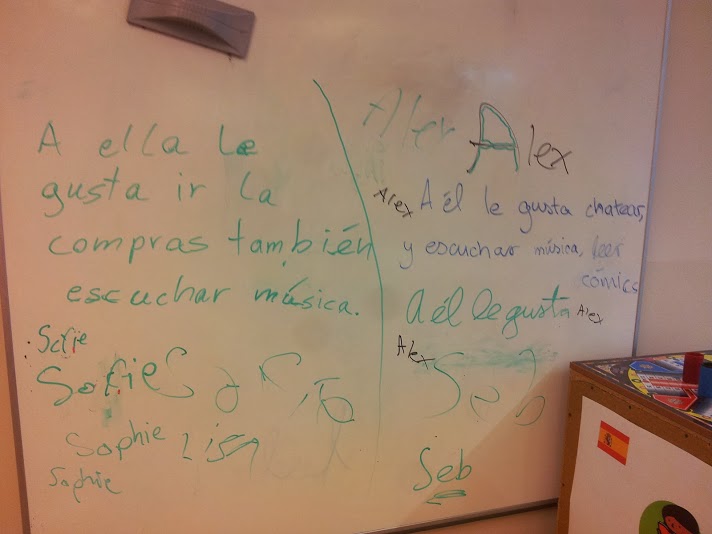
This lesson did not require much preparation nor lots of resources, apart from the matching cards which were included in my textbook Gente Joven 1 and markers for the white board. Because the students didn’t have to write in their books “the traditional way”, they were engaged throughout the lesson. Without noticing, they got to practice “gustar” a lot and to refer to different people!
Describing your home town and local area in Spanish
Another IGCSE topic is about describing where you live. First I had my grade 9 students watch this excellent video about a girl describing where she lives near Madrid (you can watch it with or without subtitles):
I then asked my students to produce a short movie like the one above about their local area. All of them did a fantastic job and here are some examples:
We watched all their videos in class and students gave feedback based on the IGCSE criteria for speaking. I was very pleased because they assessed the language and pronunciation accurately. For example, one student noticed that on the first video the student said “muchos estudiantes ir allí” instead of “muchos estudiantes van allí“. Another student also noticed that “allí” was not pronounced correctly. Students were practicing they listening skills as well as peer assessing. And I am now planning to have grade 10 watch these videos as a revision tool.
It was a simple idea really! But my students liked to create the video although it was for homework and they enjoyed watching the end products all together in class. I think they were proud of their work and they were glad they could use technology instead of pen and paper!