Spanish story: El chico cansado
This story comes from a French story on The Task Magic blog: Bob est fatigué. I wanted to recycle the structures “debe”, “tengo que” which my students already learned with Los niños prisioneros de Bolivia and I also wanted to use “está cansado”. So the boy is called Nacho and he is very tired!
Here is the script:
Hay un chico que se llama Nacho. Un día, después de la escuela, Nacho vuelve a su casa y está muy cansado. Él no quiere hacer nada.
La madre de Nacho le dice: “Nacho, tú debes hacer tus deberes.” Pero Nacho no quiere hacer sus deberes. No quiere hacer nada. Le dice a su madre: “Mamá, estoy muy cansado hoy. No quiero hacer mis deberes. No quiero hacer nada.” Pero la madre de Nacho insiste y Nacho no está contento. Él piensa: “¿Por qué tengo que hacer mis deberes? No es justo.” Sin embargo él obedece a su madre y hace sus deberes.
Después de la cena, el padre de Nacho le dice: “Nacho, tú debes lavar los platos.” Pero Nacho no quiere lavar los platos. No quiere hacer nada. Nacho le dice a su padre:” Papá, estoy muy cansado esta noche. No quiero lavar los platos. No quiero hacer nada.” Pero el padre de Nacho insiste y Nacho está enojado. Él piensa: ”¿Por qué tengo que lavar los platos? No es justo.” Sin embargo obedece a su padre y lava los platos.
A las diez de la noche, Nacho ve la televisión. Su madre le dice: ”Nacho, tú debes ir a la cama ahora, porque mañana tú debes levantarte pronto para ir a la escuela.” Nacho está cansado pero no quiere ir a la cama. Él quiere ver la televisión porque hay su programa favorito. Le dice a su madre: ”Mamá, ya no estoy cansado. No quiero ir a la cama. Quiero ver la televisión.” Pero la madre de Nacho insiste y Nacho está furioso. Él piensa: ”¿Por qué tengo que ir a la cama ahora? No es justo.” Pero obedece a su madre y va a la cama. Y cinco minutos más tarde…. ¡Él duerme como un bebé!
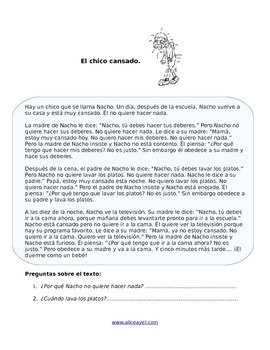
And here is the handout with comprehension and personalized questions: chico.cansado
(Of course you can also download it for free on Teachers Pay Teachers along with other useful resources!).
IB Spanish Students: el Flamenco
As you might already know, I have been reading La casa de Bernarda Alba by Federico García Lorca with my small group of Spanish language B IB higher level students. They are only girls in this group so I think they have enjoyed reading this tragedy about passionate love and freedom! My girls have just finished reading the book and I thought it might be a good idea to link it with flamenco as Lorca had strong connections with this art.
I therefore showed this video by the UNESCO explaining where this art comes from and what it represents:
I prepared a worksheet with questions about music in general and the video itself. The aim was to make my students critically think about how music and dance define a culture.
You can download the worksheet here: flamenco
or you can also find it on Teachers Pay Teachers for free!
I hope you enjoy this activity as much as we did!
Cultural input: the prisons in Bolivia (or how to engage Spanish learners)
How to get students engaged and producing a lot of language???? Well…. I recommend purchasing Martina Bex 7-day lesson plans about Los niños prisioneros de Bolivia as it is truly worth the investment! Not only did it save me a lot of prep-time, it also made my students had a meaningful discussion in the target language!
I have already mentioned Martina Bex a few times on my blog because she always produces excellent resources and she has brilliant ideas which work in the classroom. In this unit, my grade 9 students (14-15 years old) learned the structures “no debes (hacer)” and “lo que hace” and then used their newly acquired vocabulary to learn about children that live with their parents in Bolivian prisons. It made my students think and debate about children’s right and if children should be with their parents or with a fostered family: ¿Los niños deben estar con sus padres? My students really made an effort to debate in Spanish and came up with interesting reasons a favor o en contra.
Here are the two videos we watched thanks to Martina Bex:
At the end of the unit my students were assessed by having to write an newspaper article stating what was going on in Bolivia with arguments for and against and mentioning a possible solution to this issue. I was impressed by my students’ level of accuracy. Their ideas were clear, coherent and well developed! Here is an example:
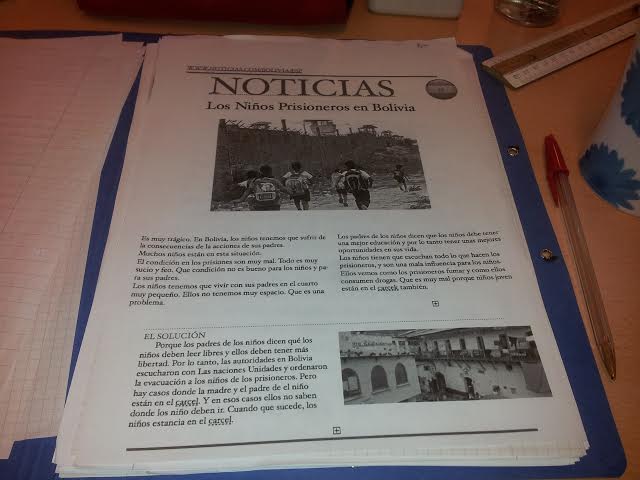
And here is a form I made to encourage my students to speak in Spanish during lessons: hablar.en.la.clase
At the end of each lesson, students decide whether they have spoken enough Spanish in the lesson by circling a number (1 being the least and 5 the most). So students have to reflect on their own performance and effort and at the end of each month or half semester, they meet with me to reflect on their results and on how they can improve and speak more Spanish.
It is also available to download on TeachersPayteachers for free!
El día de los muertos and Halloween in Spanish
There are two great videos which are to be found on Spanish Cuentos YouTube channel and which are great to talk about two major cultural events happening very soon!
The first one “La noche de brujas” is perfect for one lesson:
The video can be paused many times to do some TPR Storytelling and MovieTalk:
- 00:36 – Pause the video after the vocabulary has been introduced and ask the students to put their heads down on the table and to close their eyes. They put one hand up if the statement is true/ verdadero and they don’t do anything if the statement made by the teacher is false/ falso; for example: la calabaza es “the pumpkin” en inglés – verdadero, levanta la mano.
This is a quick and quiet way of reviewing the vocabulary and also of assessing if all the students remember it. - 00:54 – ask questions to reinforce the statement En Caracas vive la muchacha: ¿una muchacha o un muchacho vive en Caracas? / ¿una muchacha vive en Caracas o en Bogota? / ¿Caracas es la capital de Venezuela? / ¿Qué es la capital de Argentina?… This is a good opportunity to connect Spanish with geography and to see where the Latin American countries and capitals are situated on a map.
- 01:03 – The statement is Cristina va al cementerio: ¿Cristina o Pablo va al cementerio? / ¿Cristina va o no va al cementerio? / Cristina va al restaurante o al cementerio? / ¿Por qué Cristina va al cementerio? / ¿Cristina está contenta o está preocupada?…
- 01:06 – show the image on the video and ask question to reinforce the vocabulary: ¿Qué es? / ¿Qué animal es? / ¿Quién es? / ¿Cristina escucha a un perro o a un gato? / ¿Cristina escucha o mira al gato?….
- 01:13 – The key structure here is escucha a…: ¿Cristina escucha o no escucha a las campanas? One student can come to the screen/board and pint at the pictures you mention: ¿Dónde está el gato? / ¿Dónde está el cementerio? / ¿Dónde están las campanas? / ¿Dónde está la luna?…
- 01:20 – If the students know how to tell the time, they can have a guess: ¿Qué hora es?; otherwise explain the time on a clock to the class.
- 01:30 – The statement is Cristina ve un fantasma: ¿Cristina ve un gato o un fantasma? / ¿Cristina escucha o ve un fantasma? / ¿Cristina ve un fantasma en el cementerio o en su casa? / ¿Cristina está contenta o está preocupada?… Cristina tiene miedo…One student can again come to the board and point at the pictures other students mention.
- 01:36 – The statement is Cristina corre: ¿Qué hace Cristina? / ¿Ella baila o canta o escucha o lee un libro…? This is perfect to review all the verbs the students have been learning so far.
- 01:41 – The statement escucha una bruja: ¿Cristina escucha algo? / ¿Qué escucha Cristina: un gato o unas campanas o un fantasma…? Students get to review the nouns appearing in the story.
- 01:57 – The statement is grita: ¿Qué hace Cristina? / ¿Ella baila o canta o escucha o corre…? / ¿Por qué tiene mucho miedo Cristina? Students repeat all the actions and the last question is targeted at more able students.
- 02:00 – To explain the statement “es una pesadilla”, students are asked: ¿Es verdadero o falso?/ ¿Es posible o imposible?/ ¿Por qué? / ¿Es bueno o malo para Cristina?
- 02:08 – The statement is prende el televisor: ¿Cristina prende el televisor o la tostadora?/ ¿Cristina prende o apaga el televisor? / ¿Qué ve en el televisor?/ ?Es horrible o es divertido?…
- 02:15 – The statement is Cristina apaga el televisor: ¿Cristina prende el televisor?/ ¿Cristina prende o apaga el televisor?/ ¿Por qué apaga el televisor?
- 02:21 – Ask the class: ¿Qué día es en el calendario?/ ¿Es un día especial?
- 02:29 – Ask the class: ¿Cómo está Cristina?/ ¿Por qué tiene miedo?/ ¿Es posible o imposible?/¿es bueno o malo para Cristina?
- 02:33 – Ask the class: ¿Qué hay en el closet?/¿Es posible o imposible?/ ¿Es una pesadilla?
- 03:00 – Ask the class: ¿Qué ve Cristina en el closet?/ ¿Es real?/ ¿Quién es?/ Por qué es la hermana de Cristina?/ La hermana de Cristina es buena o mala?
This can lead to personalized questions such as: ¿Tú tienes pesadillas también?/ ¿Qué ves en tus pesadillas normalmente?/ ¿Tienes hermanos?/ ¿Tu hermano/a te hace sorpresas?/ ¿Tu hermano/a es bueno/a o malo/a?…
Because there are many repetitions and students are required to concentrate a great deal, I like to have brain breaks a couple of times when watching the video. This means that students have a chance to get up and move their bodies which help release dopamine to their brains and get them focused on new language again. For example I could tell my students to stand up and become ghosts or cats or bells: ahora levántate y transfórmate en un fantasma/ un fantasma que canta/ un gato que baila…. It is fun and it still relates to the structures we are learning.
Another wonderful video with lots of cultural input is “La confusión“:
I would do the same kind of lesson as above (TPR Storytelling and MovieTalk) which then would lead to cultural information about El día de los muertos:
- The fantastic website miscositas.com has a thematic unit which includes 62 pages of lesson plans, worksheets, and resources for celebrating the Day of the Dead in your classroom!!!
- There are many songs related to this celebration such as this one:
- If you are subscribed to Mary Glasgow Magazines, there are tons of articles available to download from beginner to more advanced level.
The Spanish alphabet
This is a simple activity to do with Spanish beginners when you are teaching the alphabet: students create their own alphabet page by looking for words which start with each letter of the Spanish alphabet. This is the first year in my teaching career that I do this activity and I have found out that my grade 6 students (11-12 years old) had a lot of fun doing this. They enjoyed browsing the dictionary looking for new words or simply remembering the words they had learned in class and which they could fit in a letter box.

You can download the grid with or without the Spanish letters here: miabecedario
And as you already know, I have a store on Teachers Pay Teachers where you can find many of my resources for free!