Resources for English learners: shopping and the issue of being a shopaholic.
Last week, I was writing about my new “job” which is to teach online private lessons to Spanish students who want to improve their English. (via Google hangout or Skype). For now, it is going very well and I am receiving positive feedback from my students which is always good!
Using the Edmodo platform is proving to be very useful as I keep sending many comprehensible resources so that my students can practise regularly and so that I can give them instant feedback on how well they are doing and encourage them to keep going. One of my student has to practise talking about any topic for 4 minutes as it is part of her oral exam. I found this great website aimed at ESL teachers which has a list of different topics with questions to develop the topic. One topic we have been discussing lately is fashion and one question was “Are you a shopaholic?” which I think is good expression as it derived from other expressions such as “workaholic” or “alcoholic“.
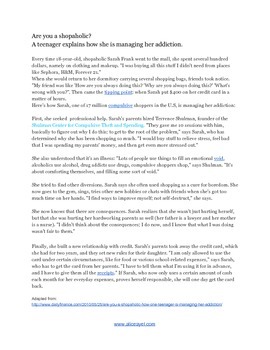
I also found an interesting article about an 18 years old girl who was a shopaholic and is now trying to solve her addiction. I adapted it and I included comprehension and personal questions.
Here is the document which you can edit to suit your own needs. (Of course you can also download it for free on Teachers Pay Teachers along with other useful resources!).
Resources for English learners: superstitions.
Although I am taking a break from my school and “formal” teaching, I have not really quit and I have now started to teach online (via Google hangout or Skype) private lessons to Spanish students who want to improve their English. It is actually very different from teaching a whole class and my students have a good level of English but they are not confident enough. They want to practice their speaking to become fluent.
To help students become more confident and fluent, I see them 3 times a week for approximately 20 minutes and I send them resources and links to keep practising on the days when they don’t have a lesson with me. I opted for 20 minutes lessons because I do believe an hour session is far too long in another language. You brain has to switch to another way of thinking and understanding and after 20 minutes or even less, you cannot concentrate that well any longer. I also think that 3 times a week instead of just one time a week is much more beneficial because acquiring a language is about practising it on a regular basis, every day if possible. This is when my resources and links come into place. They are there to make students practising a little each and every day. My resources are about providing more input. For example, students have to read an article about a topic we talked about or they watch a short video. The goal is to give them a lot of input to then become fluent in the language.
How do I provide input and keep track of my students’ progress?
I have opted for Edomodo, a platform I have used in the past at my school. Basically, Edmodo is a web-based platform that provides a safe and easy way for your students to connect and collaborate, share content, and access homework, grades and school notices. It is like Facebook but in a safe and controlled environment. With Edmodo, I can:
- Place digital resources for students to access or download.
- Share links and videos.
- Create polls for students to vote online.
- Write short summaries of lessons for students .
- Post “homework” information.
- Students can communicate to the whole class or to the teacher.
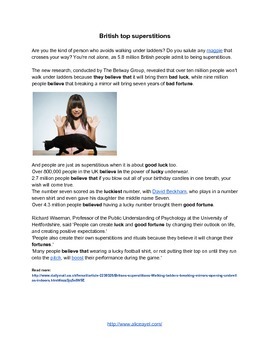
As an example, I have created an assignment based on British superstitions because it is one of the topics we talked about. It is a reading activity adapted from an article from the DailyMail. It has a True/False exercise, comprehension and personal questions, so there is a little bit of output from students.
Here is the document which you can edit to suit your own needs. (Of course you can also download it for free on Teachers Pay Teachers along with other useful resources!).
Reflection on Comprehensible Input
I haven’t updated my blog for a while now, and as I am taking a break due to my fourth baby coming at the end of September, I wanted to reflect on my last school year. I was teaching Spanish from grade 6 to 12 and I decided to turn to comprehensible input and TPRS since I was never fully satisfied with the traditional way to teach languages. I would mainly use the communicative approach but I never felt my students were making amazing progress. They achieved good and even for some excellent results at the exams but I knew that they were not fluent in the language. I knew that later on in their lives, they would say the typical “I don’t remember any Spanish from school, I can only say hello and thank you!”.
That is why I decided to try a new method, also because I love trying new teaching ideas and styles! I read the book Fluency Through TPR storytelling by Blaine Ray and Contee Seely, I purchased many lesson plans from Martina Bex which I did with my different classes and of course I read articles and viewed videos from experienced TPRS teachers to understand and acquire the method. I guess I now need to attend a workshop to see everything live but I will wait until my baby is born!
The point is that I and most importantly my students enjoyed my new way of teaching. For the first time, I was teaching more than 90% in the target language in every lesson and my students could understand everything. They had fun and at the same time were acquiring the language without much effort. At the end of the school year, my students could speak and write in a way that I would have never imagined they would have done with the traditional method. Here are some examples of written work from a 7th and 8th graders (without any help!):
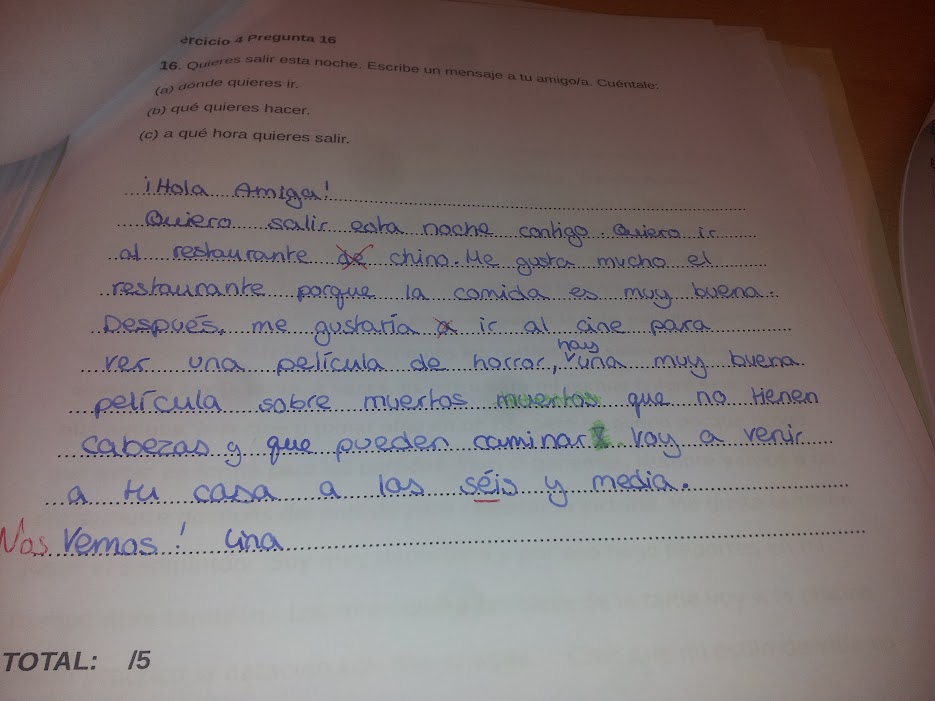
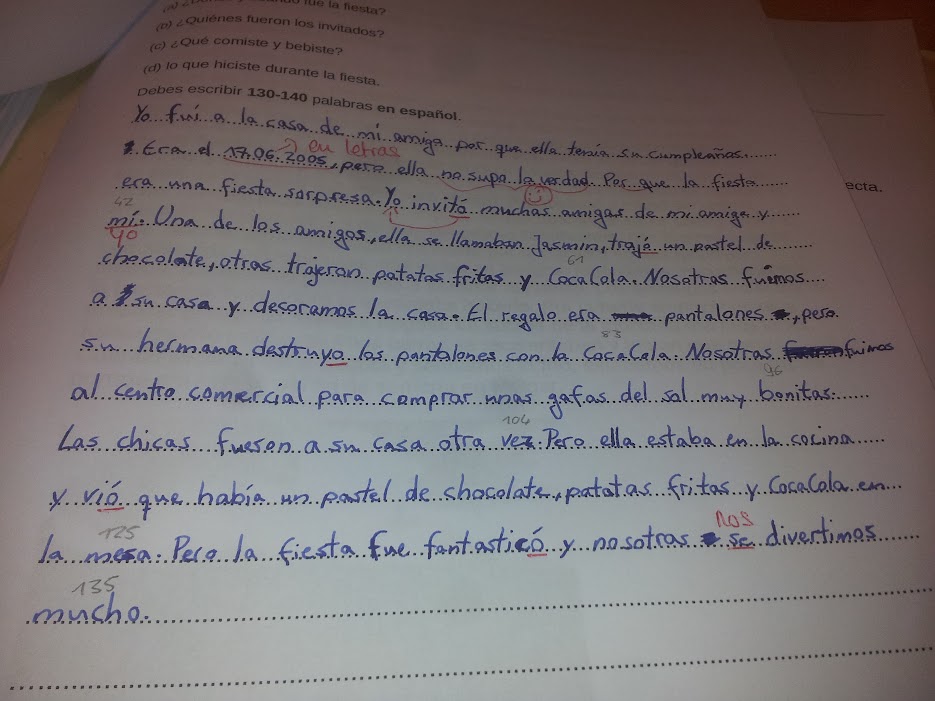
I asked my students to fill in the self-reflection sheet made by Martina Bex and I requested them to be honest (since I was not going to see them anyway next year!). Here are some of the comments I got:
“The first day in Spanish class was awesome and I learned very much in 45 minutes” 6th grader.
“Learning Spanish this year has benefited me because I am now able to speak Spanish with my friend who lives in Madrid and my other friend who lives in Peru.” 6th grader.
“I really liked reading the book (Agentes secretos y el Mural de Picasso). It was very interesting!” 6th grader.
“I liked to answer questions out loud in Spanish because then I know that I can speak Spanish and that makes me proud.” 6th grader.
“I liked to contribute ideas to a story and learning a song because I love music and we are more social if we all talk together and discuss in class” 8th grader.
“I loved acting in a story because it was fun.” 8th grader.
“I liked the acting out we did in class because it helped me understand things more clearly.” 8th grader.
There were no negative comments and when they rated their abilities on a scale of 1-10 to read, speak, write and understand Spanish, they were no grades lower than 5. Students showed confidence and were proud of their achievements! It was definitely a positive teaching and learning year and the icing on the cake was that 100% of my grade 1o students achieved A-A* at their IGCSE exams. In fact only one student got an A!
How to encourage students to produce comprehensible output on sports

My grade 7 students (12-13 years old) did comprehensible presentations about some popular sports in Hispanic countries. First, I wanted to model a presentation because whenever my students produce Spanish output, the language is complicated and often translated from their mother-tongue which doesn’t make sense in Spanish. This time, I first showed them a sample presentation I created about baseball in the Dominican Republic and I then gave them a list of Hispanic sports and countries to choose from. My students had to work in pairs and their objective was to ensure their presentation would be comprehensible for the whole class with a quiz at the end to check that the audience had learned something. I also encouraged them to search the information on Spanish websites and on es.wikipedia.org so that they would not translate. I explained that they should look for the information that they understood because that meant that the rest of the class would also understand it.
I think that the result was quite successful and productive and it has motivated me to make my students create comprehensible output. The key is to model output and to look for comprehensible input!
Here is the presentation I created: El beisbol en la Republica Dominicana
and of course you can also download it for free on TeacherspayTeachers.
How to use a mini story in a Spanish beginner class
I have become a fan of TPRS because I do believe it is the most efficient way so far to help students develop both fluency and accuracy in Spanish. However, I am new to the techniques and although I read the Big Green Book: Fluency through TPR Storytelling, I guess that my biggest worry is that I won’t have enough worksheets/activities for students to do during my lessons because I have become so used to producing tons of resources in order to keep them busy. Needless to say I have found out that my students can actually stay engaged while listening to comprehensible input and that I do not need to have tons of worksheets ready for just one lesson. And this is what I love about this method: it does not require a lot of preparation but at least three key structures to repeat!
And here is one fun activity that came to my mind just before my lesson with 6th graders started. I quickly wrote this mini story on the board as a mean to circle the key structures “tiene“, “abre” and “hay“:

After circling the structures, I asked my students to create their own mini stories by changing the words underlined. I left them one minute to think silently about their mini stories. There was no writing required because I wanted them to speak. After the one minute had gone, my students had to tell their stories to another classmate. Some of their stories were actually so much funnier than mine and I was amazed by their accuracy at such a beginner level. This nearly took the whole 40 minutes period and my students were happy because although the class was in Spanish all along, they understood everything and they could communicate too.