🎉 Don’t Miss Our Community Gathering – LIVE on Zoom! 🎉
Bonjour wonderful French learners!
This is your friendly reminder to join our special 1-hour LIVE session tomorrow.
Let’s make it unforgettable together!
📅 When & Where?
Tuesday July 1st
4pm UK / 5pm France / 11am EST / 8am PST
Click here to join on Zoom
Meeting ID: 874 9812 3064
Passcode: 058671
🌟 What’s New? Introducing… Karaoké! 🎤
This month, we’re rolling out a brand new feature: karaoké!
Experience French in a whole new way: read, listen, and then SING a beginner-friendly story together.
We’ll focus on must-know phrases like “chercher” (to look for), “trouver” (to find), and “avoir besoin de” (to need).
Why is this awesome?
Singing stories helps you remember full sentences, making French stick in your mind, way better than memorizing single words!
🚀 Boost Your Confidence & Enjoy French!
Whether you’re a returning member or brand new, everyone is welcome.
This is your chance to boost your confidence, make connections, and enjoy French in a joyful, pressure-free way.
Set your reminder now & let’s sing, laugh, and acquire together!
À très bientôt. See you tomorrow! 💬🎵
🎤 Sing Your Way to French Fluency! Join Our Special July Live Gathering 🎶
JOIN ME FOR 1 HOUR LIVE
FOR OUR JULY COMMUNITY GATHERING !
Tuesday July 1st
4pm UK / 5pm France / 11am EST / 8am PST
Mark your calendar and get ready for an unforgettable session!
Everyone is welcome, whether you’re a returning member or brand new to our group.
Join me on Zoom
Meeting ID: 874 9812 3064
Passcode: 058671
🎉 Discover Our New Karaoké Feature!
This gathering will be extra special as I’ll be introducing our brand new site feature: karaoké!
Get ready for a unique, musical French experience.
We’ll read and listen to a beginner-friendly story together, filled with essential high-frequency structures like “chercher” (to look for), “trouver” (to find), and “avoir besoin de” (to need). Then, we’ll sing the story as a group!

It’s a fun, memorable way to make full French sentences stick in your brain, much more effective than memorizing single words.
In just one session, you’ll feel the language come alive!
🤗 Why Join? The Power of Community
Joining our live gatherings means more than just learning French. It’s your chance to:
Make new friends and get involved with fellow French learners. #youarenotalone
Grow your vocabulary and comprehension through stories. #storyispower
Relax and let go of stress in a supportive, friendly environment. #relax
Communicate with real people in French, at your own pace. #youcandothis

Remember, there’s no pressure to speak if you’re not ready—you can participate using the live chat and still be part of the fun!
🚀 Boost Your Confidence & Have Fun!
I would absolutely love to see some new faces join us and share in this joyful experience.
This is your moment to boost your confidence, make connections, and enjoy French in a positive, pressure-free way.
So, set a reminder and come join the conversation! Let’s sing, laugh, and learn together.
Your French journey is about to get even more exciting!
À très bientôt—see you next Tuesday! 💬🎵
French news: Unlocking French Joy: How & When to Start Reading + A Habit That Sticks! 🇫🇷✨
Coucou les membres de la communauté,
Community Spotlight: When Should You Start Reading French? 📚
This week in our vibrant Community Chat, @brookinsfamily asked a wonderful question:
“Bonjour! I’m using this for my daughter for French for our homeschool. We’ve loved the videos so far (still in Baby Stage!) but I’m wondering when and how I should start to integrate reading the stories? Is there an order that makes sense? Or do we just pick some? When I’m assigning things for her, how often should I assign the videos vs the written stories? Thank you!”
Thank you, @brookinsfamily, for voicing a question that many parents and learners share!
My Response: Balancing Listening and Reading for Natural Progress 🚀
At the Baby Stage, the heart of language acquisition is listening and understanding spoken French, just as children do with their first language.
However, if you are curious or excited to read, you can absolutely begin introducing written stories alongside the videos.
A great way to start is by choosing the written stories that match the videos you have already watched.
This familiarity will make the reading experience enjoyable and successful.
Stick to stories that correspond to the same stage as the videos to ensure vocabulary and grammar remain accessible and not overwhelming.
That said, if you want to reread a favorite or explore something new, let your curiosity be your guide!
The most important ingredient is your enjoyment and motivation to engage with French.
Here’s a simple routine you might find helpful:
Alternate between videos and written stories. For example, watch a video one day, then read the matching story the next.
You can also read the story after watching, and then listen to the audio or re-watch the video while following along with the text.
This gentle repetition across formats helps deepen comprehension and memory.
Exciting News: Our Podcast Is Now on Pocket Casts! 🎧
My Dear Man & I are delighted to announce that our podcasts are now available on Pocket Casts!
This means you can enjoy my conversations with fascinating guests on one of the most user-friendly podcast platforms, making it even easier to listen on the go, whether you’re at home, in the car, or out for a walk.

Simply suse this direct link to start listening: Pocket Casts
Happy listening!
Inspiration Corner: A Habit That Makes French Stick 🌱
As we all know, the journey to French fluency is built on small, consistent steps.

This week, I want to share a gem from our community: Lette Berhe’s Substack post, “The Little Habit That’s Made My French Practice Stick”.
Lette beautifully captures how a simple, daily habit can transform your language experience and make progress feel effortless.
I highly recommend giving it a read for a dose of motivation and practical tips!
Merci & A Gentle Reminder 🌷
Thank you to every member of our community for your dedication, curiosity, and kindness.
Remember, in language acquisition, the journey truly is the reward.
Every story you listen to, every word you read, and every moment you share with French brings you closer to fluency and joy.
With gratitude and encouragement,
P.S. Come and connect with other members in the community during a live Community Session. Click here to join!
French news: 🌱 Progress, Not Perfection: Your French Journey & an Exciting Summer Intensive! ☀️
Coucou les membres de la communauté,
Celebrate Your Stage—Mistakes Mean You’re Growing! 🎉
This week, I want to start by answering a thoughtful question from one of our Dear Member, Les:
“After watching the video I am pleased with my comprehension and am very happy after listening to the audio underneath it. (love the voice actors by the way!!) My question lies with the questions under the lesson. I understand the questions and have an idea how to answer. Am I supposed to be able to answer all correctly before moving on to other lessons?“
Thank you, Les, for sharing your experience and your kind words about our voice actors!
Here’s the truth: when you start producing French, whether answering questions, speaking, or writing, you might make mistakes or sound “non-native.”
That’s not a sign of failure; it’s a vital developmental stage in language acquisition.
Every new word you try, every sentence you attempt, is a step forward.
Just as a child stumbles before walking, your French will grow stronger with every effort.
Celebrate where you are right now, and trust that your ability to communicate will develop naturally over time.
Progress, not perfection, is what matters most. 🌟
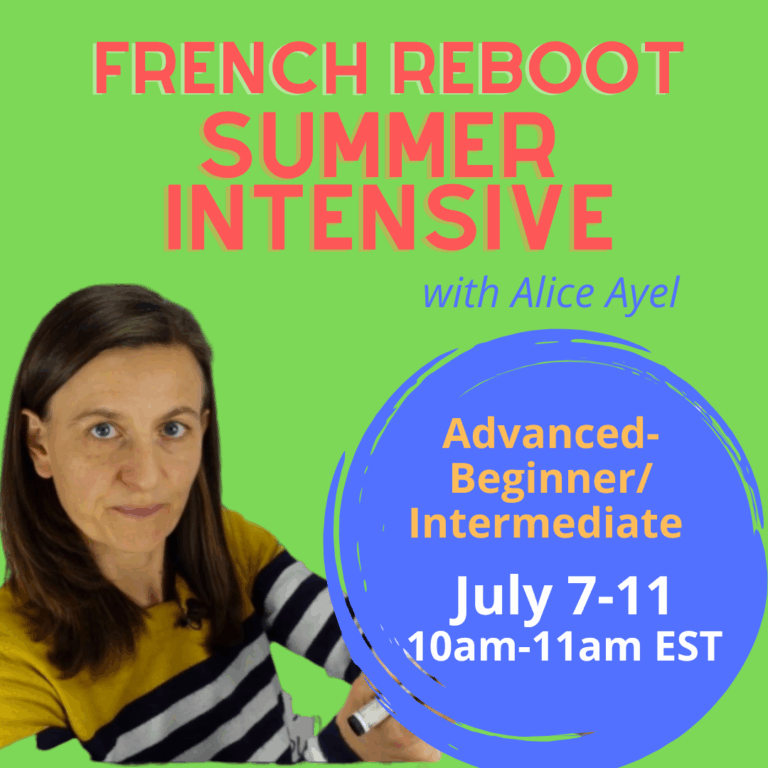
☀️ French Reboot! 5-Day Summer Intensive for Upper Beginners & Intermediates 🚀
Are you ready to give your French a gentle push to the next level?
Join me for French Reboot!
A 5-day Summer Intensive designed especially for “advanced-beginner” and “intermediate” learners.
From Monday to Friday, July 7–11, 2025, you’ll enjoy daily sessions that will help you:
-
Understand French effortlessly
-
Think in French without translating
-
Speak French spontaneously
Each session is carefully framed and scaffolded for all learners to feel supported.
Here’s what you can expect:
Listen to a compelling story to receive rich, abundant input.
Then, read the story to effortlessly acquire vocabulary and structures.
Finally, narrate the story in your own words, a powerful step that helps you internalize the language and make it truly yours.
This immersive experience will boost your confidence and fluency in just five days!
All sessions are recorded and available to you indefinitely, so you can revisit them anytime.
Spaces are limited and fill up quickly, so register as soon as possible!
Just click here to reserve your spot: French Reboot! 🌻
Thank You for Trusting the Process 🙏
Thank you, dear members, for your dedication and for trusting the language acquisition process.
Remember: the journey is the reward. Every step you take, no matter how small, is progress.
Stay with us! There’s so much more to discover, and your presence makes our community vibrant and inspiring.

Together, we’ll keep growing and celebrating every victory along the way! 💪✨
With gratitude and encouragement,
P.S. Come and connect with other members in the community during a live Community Session. Click here to join!
French news: 🚀 Be the First! Beta Test Our New Android App & Discover Fresh French Stories! 📱✨
Coucou les membres de la communauté,
📲 Exciting News: Android App Beta Testers Needed!
We’re thrilled to announce the beta test launch of our brand-new Android app!
This app is designed to make your French journey even more interactive and enjoyable.
While the iOS version is on its way, we’re currently looking for 5 more enthusiastic volunteers (we already have 10!) to try out the Android app over the next few days.
Be among the very first to explore this exciting new way to acquire French!
Simply reply to this message or email us at contact@aliceayel.com.
Help us shape the future of French acquisition on aliceayel.com! 🌟
📚 New Exclusive Resources: Stories for Every Level
🏰 For Upper Beginners: A Princess from Mali
We have just released a brand-new story for upper beginners: an arrogant princess from Mali!
Mali is a fascinating country in West Africa, known for its rich culture, music, and history.
How to make the most of this story:
-
Watch the video – I tell the story using drawings and gestures to help you understand every detail, even if you’re new to French! 🎥✏️
-
Read and listen – Click the Audio sync view button at the top of the page to read along and hear the story at your own pace. 🎧📖
-
Narrate the story – Try retelling the story in your own words, in French or your native language. This will help you remember and truly make the story your own! 🗣️🌍

Click here to discover the story of the arrogant princess!
📜 For Advanced Learners: Memories of Gaston de Ségur
When you have reached an advanced level, we have a new authentic text from the memoirs of Gaston de Ségur.
In this anecdote, Gaston shares a story about his mother during a mysterious night when she heard a noise.

Click here to read and listen to this story!
Who was la Comtesse de Ségur?
She was a famous French writer, beloved for her children’s books and moral tales.
Reading authentic texts like this one will deepen your understanding of French, and also immerse you in the culture and history of France. 📚🇫🇷
🙏 Thank You & Save the Date!
A big thank you to everyone who joined our monthly community gathering last Wednesday!
Unfortunately, our session ended abruptly due to a power cut in my area! Thank you for your understanding and patience.
Our next live meeting on Zoom will be Wednesday, July 2nd.
Mark your calendars and get ready for another hour of French fun and connection! 🗓️💬

Thank you for being such a vital part of our vibrant French learning community.
We can’t wait to hear from our new app testers and see you all at our next gathering!
With gratitude,
P.S. Come and connect with other members in the community during a live Community Session. Click here to join!