Talk about a picture in Spanish
A picture can be a great start for a conversation when it is hard to get students talking in the target language. In my present school, we prepare grade 9 and 10 for the IGCSE exams and one part of the exam is about students having to converse with the teachers about different topics they have previously learned. As a matter of fact I do find that the topics are repeating themselves year after year: school routine, home life, self, family and personal relationships … And after a while students get bored about talking about the same stuff over and over again! I do find myself lacking of imagination to differ my lessons about the same topics we teach in grade 6 and in grade 9!
In that way pictures can help spice up the lessons. I already mentioned the wonderful website Spanish Playground which has a series of posts entitled Learn Spanish with pictures. Each post includes a photograph with different activities to help students master the vocabulary and gain confidence with the language. As an example, I am going to use the first day of school photograph to talk about school routine. The first activity involves the teacher describing the photo by pointing at the objects and people and using gestures, facial expressions and actions to help students understand what the words mean. Once students understand the key words, the teachers can then ask questions from Choose the answer (2) and Pointing and counting (3). Then the teacher can move on to ask questions in Yes and No (4) to practice more of the vocabulary used in the description. When students are comfortable enough with the Spanish words to produce them easily, the teacher can then include the questions in Say a little more (5). Finally the questions in What about you? (6) give the students a chance to talk about themselves. I find this is perfect to gradually make students have a conversation.

I have also created a board on my Pinterest account entitled Pictures / paintings / photos where I pin anything which I find interesting, funny, cultural or which relates to a topic. I contemplate showing a picture from this board randomly to students and start a conversation from there. This could be a good starter or end of a lesson.
What do you think? How do you use pictures with your students?
Another story script in Spanish: ¡No es aceptable!
Following my first story script in Spanish to practice classroom instructions, I have just finished creating another one which reinforces classroom intructions and which introduces one important question word: ¿Por qué?. It also introduces other key phrases from the Michel Thomas method such as es así and lo.

How would I tell the story? First I would start the lesson by reviewing classroom instructions: Sacad las cosas / Escribid en el cuaderno / Mirad a la pizarra… We could play Diego dice… where students have to carry out the instructions, one student being the teacher. I would then have students sit in a circle around me and I would start telling the story TPRS style. I would not follow the script rigorously. For example I could change the names of the characters and say names of students in the class. Those students would come next to me and play their part in the story. I would never speak in English. Key structures would be on the board with their English translation and I would point at them when telling them in the story. If there is the need to another word to be translated, I would write its English meaning on the board but I would not say it. Students will therefore understand that there is no English speaking during the Spanish class. This video by Martina Bex is a good example on how I would tell the story:
Here is the story script:
2. ¡No es aceptable!
Key structures:
-
No es aceptable – It is not acceptable
-
¿Por qué? – Why?
-
Porque – Because
-
Es así – It is that way
-
Saca – He/she takes out
-
Escribe – He/she writes
-
No escribe – He/she does not write
-
Abre – He/she opens
-
Lo – It
-
Quieres – You want
-
Quiero – I want
Script:
Hay una chica. Se llama Elena. Está en la clase de Pedro. Elena saca sus cosas de la mochila. Saca un bolígrafo de su estuche y escribe sobre la mesa. La Señora Martinez dice “¡No Elena, no es aceptable!”. Elena pregunta “¿Por qué no es aceptable?”. La Señora Martinez dice “Es así, no es aceptable”. Entonces Elena no escribe sobre la mesa. Saca su cuaderno, lo abre y escribe en su cuaderno.
Luego la Señora Martinez dice “¡Clase, abrid el libro de matemáticas!”. Pedro saca el libro de matemáticas y lo abre. Elena saca el libro de matemáticas y lo abre. Escribe en el libro de matemáticas. La Señora Martinez dice “¡No Elena, no es aceptale!”. Elena pregunta “¿Por qué no es aceptable?”. La Señora Martinez dice “Es así, no es aceptable escribir en un libro”. Entonces Elena no escribe en el libro de matemáticas. Abre su cuaderno y escribe en su cuaderno.
Después la Señora Martinez dice “¡Clase, mirad a la pizarra!”. Pedro mira a la pizarra. Elena se levanta y escribe en la pizarra. La Señora Martinez dice “¡No Elena, no es aceptale!”. Elena pregunta “¿Por qué no es aceptable?”. La Señora Martinez dice “Es así, no es aceptable”. Entonces Elena no escribe en la pizarra. Se sienta en su mesa. Abre su cuaderno y escribe en su cuaderno.
Pedro pregunta a Elena “¿Por qué quieres escribir en todas partes?”. Elena le dice a Pedro “Porque quiero escribir”. Pedro pregunta a Elena “¿Qué quieres escribir en todas partes?”. Elena dice “Quiero escribir que te quiero”.
What do you think?
Helen Keller: an inspiring story
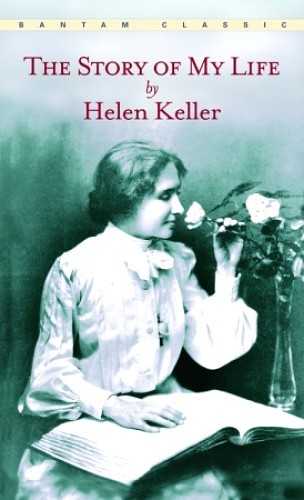
When I was a child, I read The Story of My Life by Helen Keller. I read this book over a few days and it stuck in my mind. It is an incredible story of a courageous individual who overcame tremendous odds with the help of a tremendous teacher, tutor, mentor and coach all at the same time. Rendered deaf and blind at 19 months by scarlet fever, Helen Keller was prone to fits of violence, and seething with rage at her inability to express herself. But at the age of 7 this wild child was transformed when Anne Sullivan became her teacher. I can still remember the part in her story when she describes the day “Teacher” led her to a stream and repeatedly spelled out the letters w-a-t-e-r on one of her hands while pouring water over the other. She could finally communicate!
Today thanks to Open Culture, I stumbled upon this vintage footage from the 1930s where you can see Helen Keller along with Anne Sullivan in the flesh and discover how she learned to talk. It’s amazing to watch, particularly through the stirring finish.You can see the bond between the “student” and the “teacher” and it is a great lesson of perseverance: never give up!
Henry Van de Velde exhibition
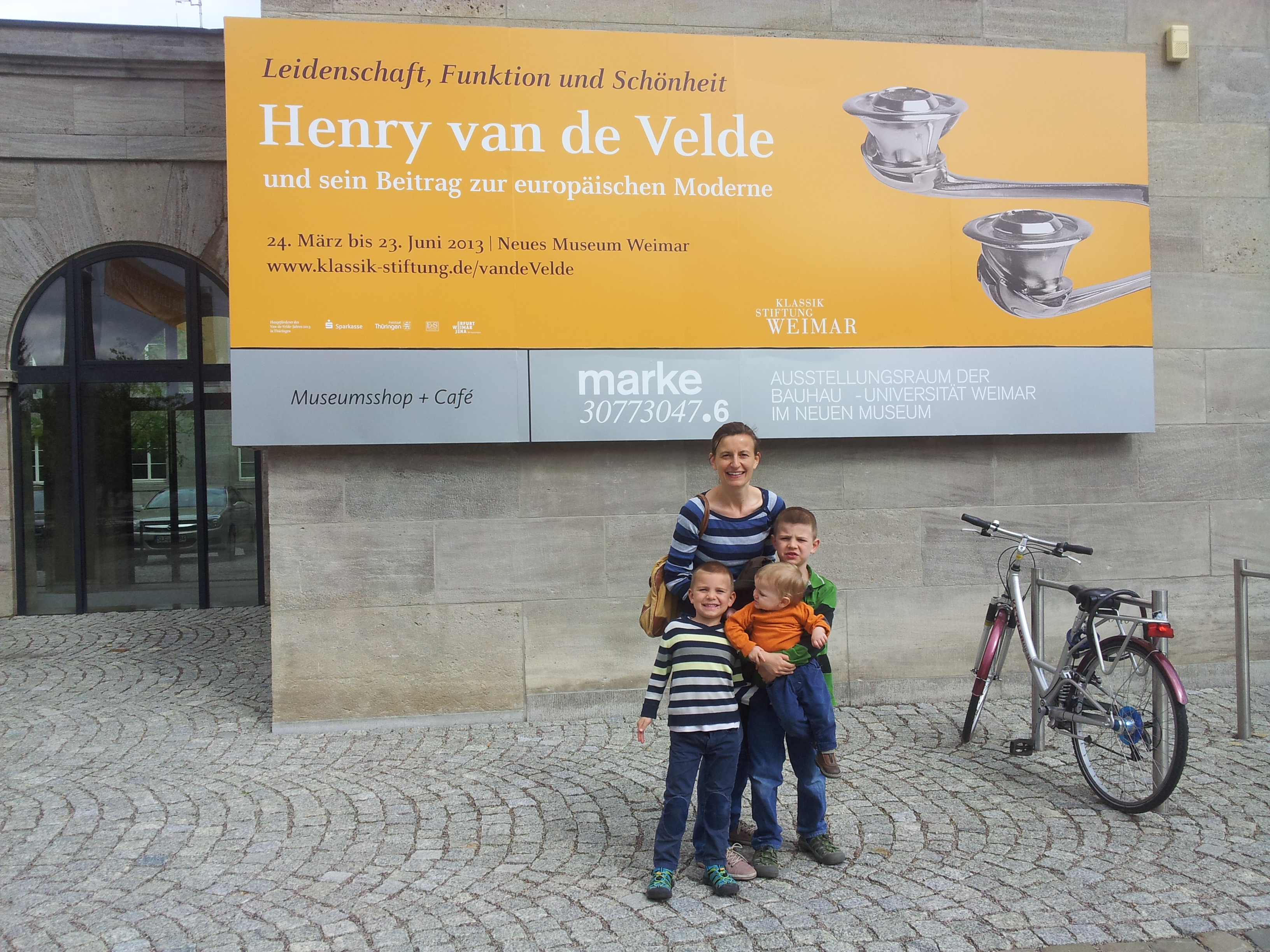
On Saturday, my family and I discovered the work of Henry Van de Velde, one of the originator of the Art Nouveau style. As a matter of fact Van de Velde was a Belgian architect, painter and interior designer who spent most of his life in Germany and especially in Weimar. He lived in a house right up the street where my present school is located, in a house he built for his family once it had grown to seven people. The house is called House Hohe Pappeln (Lofty Poplars) and was a a popular venue for artists and art lovers. When Van de Velde sold the house after the first world war, all he received for it in real terms were 2.20 guilders because of the galloping inflation in Germany. The house has been restored since the German reunification and is open to the public.

The exhibition we saw on Saturday is to celebrate the 150th birthday of Van de Velde who came to Weimar in 1902. It was impressive to see all the work he designed from buildings to furniture. We could easily imagine that people could live in an art nouveau-inspired house with art nouveau furniture, silverware, crockery, jewellery, cigarette cases, etc… If you understand German or wanted to practice it or even wanted to use it in a German class, the web page about the exhibition has included the audio guide with the pictures of each object, which you can listen to from the comfort of your home.
Follow the life of an astronaut
What is more fascinating to little boys than seeing a real astronaut on a mission?! That is what Chris Hadfield did as the first Canadian to walk in space. He said that “Space was too good not too share it“ so he tweeted about his life at the space station, sharing striking images of the Earth from space.
He also filmed himself to answer questions littles boys would ask like “how to brush your teeth in Space?“:
or “how do you sleep in Space?“:
Isn’t that cool? Chris Hadfield got nearly 1 million Twitter followers which is also amazing. Anyone could see for free the life of an astronaut live. I truly believe we are living through an amazing century and I am truly grateful!