French game to recycle and repeat: Jean-Jacques Julier
I am back home after a big road trip which took my whole family all the way down to Portugal, then Spain and finally to La Bretagne in France. We got to discover beautiful places and meet amazing people and we also had the chance to reunite with family and old friends. It was a wonderful summer holiday but everything comes to an end and it is now back to reality! My boys are back to school but… I am not! I am still on maternity leave which gives me the chance to continue with online private lessons and also create languages courses and resources… I have tons of ideas and projects racing in my mind but I need to slow down and take it one step at a time. The number one priority is to look after my family and especially after boy number 4 who is turning 11 months old in a few days! I then want to post more useful ideas and resources for language teachers and learners, to design a valuable French curriculum map ( à la Martina Bex for Spanish) because I have noticed that there is not much comprehensible input stuff available online for French teachers. I also want to share more recipes which are simple to do and which can feed a numerous family. I would loooove to become a certified TPRS teacher (but let’s see if I get more people who want to acquire a language with me!)… And so many other things like doing more yoga or singing in a choir again…
To start off on the right foot, I have decided to re-start the yoga camp with Adriene to re-center and to help me achieve all the things I would like to achieve! If I was at school and had a homeroom, I would definitely write a mantra on the board in the morning and spend a few minutes meditating the mantra with my students. The mantra today was I embrace so I would ask students what they would lean into today, what they would hug and embrace. What a fabulous way to start the day and to keep positive energy going on!
I also want to share a great game that I have been using in my French lessons online and which gives learners the opportunity to repeat and recycle structures and vocabulary. It is in fact a game for English learners called Pancho Carrancho by Ramiro Garcia and I adapted it in French so that now the guy is called Jean-Jacques Julier.
I wanted to practice the stuctures il achète and il n’achète pas with my French learner. So I started by saying: ” Jean-Jacques Julier achète des livres. ” The learner had to answer: ” Non, Jean-Jacques Julier n’achète pas des livres. Jean-Jacques Julier achète des chaussures. ” and then I would continue: ” Non, Jean-Jacques Julier n’achète pas des chaussures. jean-Jacques Julier achète du pain. ”
I tried this game thinking that it would end up quickly because of my learner’s short range of vocabulary. But so wrong was I! I should really have put more faith in my learner’s ability to retain vocabulary! Building up stories made him retain much more vocabulary than I thought and I was amazed at all the words he was telling me from older stories. We ended up playing the game for like 10 minutes just the two of us! This is the power of teaching comprehensible input and TPRS!
I then realized that this game could be played in so many other ways, not just to review vocabulary but also to practice pronunciation of a particularly difficult sound (you could change Jean-Jacques Julier by any other name with a particular sound.) or to practice tenses and grammar structures. For example, as learners advance you could use: ” Jean-Jacques Julier a regardé un match de foot hier soir. ” and then the learner could reply: ” Non, Jean-Jacques Julier n’a pas regardé de match de foot hier soir. Jean-Jacques Julier a nagé ! “. In this case, you would practice le passé-composé instead of practicing vocabulary.
This game doesn’t require any planning or supply and it can be done as a starter a warm-up activity, as well as a brain break or to end a lesson.
What about you? Can you share a quick and fun game to repeat and recycle structures?
How to build up to a story in French?
My online learners are acquiring French at a fast and steady pace and it is amazing to watch them progress naturally. Unlike last school year when I was trying to use TPRS along with my other resources, I have decided to give it a full go following each of the three steps… And it all makes sense! It is obvious that learners need loads of input first, that they need to listen and to comprehend and that they will speak when they are ready to do so! I mean being the mother of a four years old made me realize that I do it unconsciously. For instance, my son has some trouble with the colors, he is still confused with green and blue. So what do I do ? I show him the leaves on a tree and I ask him: what color are they? He takes time to answer, so I ask him a closed question: are they green or red (because I know he knows the color red)? and then he can answer and he is actually happy because he got the answer right.
So what about my French learners? Well, they first started to acquire many high frequency, structurally important words (like the most commonly used verbs and phrases), especially verbs through Total Physical Response so that we could start creating stories.
The main challenge for me is to think of the structures I want my learners to acquire and to have a story script ready so that I can stay “in bounds” with my objectives. Luckily I purchased Putting it together – TPRS for English Language Learners, Teacher’s guide by Elizabeth Skelton and Denise Milligan. The book is aimed at English teachers who use TPRS but it has really helped me putting French together for my learners! The book also starts with TPR to then move on to scenarios and stories. Each chapter contains mini-stories and one main story based on a general topic. The main story recycles all the vocabulary from the mini-stories. It is therefore much easier for me to plan a logical sequence of sessions which build up to a main story and which include high interest vocabulary.
Diane Neubauer, a high school Chinese teacher who has taught five-year-olds through adults, explains very clearly how TPRS works in an article for FluentU. So here are the three steps I follow with my learners:
- First we establish meaning and we use the target vocabulary in the imperative mode through commands. I show the learner a gesture via the webcam and I then ask him or her to do it. For example the gesture for ” mange ” is to pretend to eat and I would ask the learner ” mange une pizza !”.
- I then ask personalized questions in order to provide comprehensible input of the target vocabulary. I don’t expect my students to reply with full sentences but I expect them to answer by ” Oui ou Non ” or just a word. Some questions are: ” Tu aimes la cuisine américaine ? Tu aimes la cuisine italienne ou espagnole ?…” These questions lead to an interesting discussion and without noticing the learner “is experiencing new language deeply in the context of language s/he already knows.”
- Finally, we can use that limited amount of new language in a story-like format. I ask, not tell, the story, and “I use at least 90% French to do so. The learner contributes ideas to further the story, including who the characters are, where they are and some of the key aspects of what happens in the story. It is a collaborative process which is very engaging and fun. By hearing and responding to an awful lot of French, the learner gets real language in his/her head and start to speak naturally, at his/her own pace.“
Here is a mini story co-created with a learner and which I adapted from Putting it together. It targets the structures:
-
il ou elle aime -s/he likes
-
la cuisine – food
-
tous les jours / les matins / les midis / les soirs – everyday/morning/noon/evening
C’est Suzanne. Suzanne aime la cuisine mexicaine. Elle adore la cuisine mexicaine. Elle veut manger mexicain tous les jours. Tous les matins, elle mange des tortillas avec du guacamole. Elle mange aussi mexicain à midi. Tous les midis, elle va à son restaurant mexicain préféré et elle mange des burritos. Elle mange aussi mexicain tous les soirs pour le dîner. Elle prépare des nachos et des soupes mexicaines et elle les mange tous les soirs. Elle mange beaucoup mexicain. Elle mange trop mexicain. Maintenant, elle n’aime plus la cuisine mexicaine, elle aime la cuisine italienne !
La flognarde aux pommes or The French apple flan
This is a long overdue recipe which is a popular dessert in France and at home! It is kind of easy to prepare and requires few ingredients, well… The French basics for a dessert which are flour, sugar, eggs, butter and milk and a bit of alcohol but optional! This delicious dessert is similar to a clafoutis (another French staple) and resembles a big generous pancake. It always proves a big success among the little (and big) ones!
https://goo.gl/photos/apV9F14ZnuYzfoEN7
Enough talk, here is the recipe:
- Melt 40 g butter. I usually do melt it in the microwave for 1 minute or so but you can also do it in a pan.
- Preheat the oven to 210 degrees.
- Whisk together 4 eggs and 100 g caster sugar.
- Add 100 g flour little by little, a pinch of salt, the melted butter and 30 cl of milk. Whisk the mixture until it becomes smooth and without lumps. Add 5 cl of rum if you wish (I strongly recommend it as it gives a lovely kick to the overall flavour!).
https://goo.gl/photos/fDnWZMZ4a7MEdrjK9 - Peel and roughly cut 2 to 3 apples. Add the apples chunks to the mixture.
https://goo.gl/photos/wjA3HnSqqrnqk8uo6 - Pour the mixture in a mold and put in the preheated oven at 210 degrees for 10 minutes or so until the dough starts to swollen. Lower the oven temperature to 180 degrees for about 20 minutes until the cake is firm and golden on top.
Enjoy warm or cold!
The lion's breath or how to refocus
Last year when I was teaching Spanish, I became a fan of brain breaks. According to Dr. Lori Desautels: “They refocus our neural circuitry with either stimulating or quieting practices that generate increased activity in the prefrontal cortex, where problem solving and emotional regulation occur.”
I started to use brain breaks because the length of teaching time was too long (a class would last 40 minutes or in the worst case scenario, I would end up teaching a double period of 80 minutes!) and my students desperately needed a break to move around and refresh. Secondly, because I desperately needed a break too!!! Now, to me having a brain break is really about getting out of seats and moving around, stretching the body. The brain needs a break and the body needs to move! So I usually tend to do yoga poses and breathing exercises.
The other day, when I was doing my morning yoga practice with Adriene (yes, you know the #yogaeverydamnday !), the lion’s breath reminded me of my teenage Spanish learners! I remembered how shocked they were at first to see me, their serious teacher, sticking my tongue out with my eyes wide opened looking at the ceiling. They must have thought I got crazy! They became even more anxious when I asked them to do the same!!! Soon enough, they were laughing out loud and releasing tons of energy because everybody looked like a fool! And actually some of the benefits of this pose are:
- Relieves tension in the face and chest
- Improves circulation of blood to the face
- Keeps your eyes healthy by stimulating the nerves
- Helps prevent sore throat, asthma, and other respiratory ailments
As we are coming to the end of the school year, I thought this particular brain break would be useful if your students are getting excited and unfocused.
When I explain the exercise or pose, I always keep in the target language. In that case I would tell my students in Spanish: “Ahora, vamos a hacer la respiración del león. Abrid la boca, tirad la lengua. Inspirad y espirad.” My yoga breaks became so successful that one day, a grade 7 boy asked me for it: “Señora Ayel, respiramos ahora“. I was so happily surprised. Not only, the boy wanted a break, he had also remembered how to describe it in Spanish!!!
What about you? Are you a fan of brain breaks too? What do you usually do?
How can a children's book be for everyone?
I am always on the look for interesting funny stories and at the same time stories which are comprehensible to my learners. A few months ago when I was busy breastfeeding, I was reading the TPRS bible “Fluency through TPR storytelling” by Blaine Ray and Contee Steel and one chapter entitled “Kindergarten Day” caught my eyes. Susan Gross, my other TPRS heroe (as well as Sabrina Janczak and many other passionate teachers!), innovated this idea which was inspired by the recommendation that teachers read stories to students. The teacher would select a children’s book with colorful pictures and she would read the story as done in elementary school. The benefits of this activity are that it provides interesting comprehensible input and the affective filter is low. I do read quite a few bedtime stories to my boys and those stories entertain everyone of us, from my 10 years old to my 4 years old to even myself!!!
Therefore even though I am teaching adults, I looked for an entertaining children’s story with animals. And I found this little gem ” Aboie, Georges ! ” by Jules Feiffer which is the perfect story for beginners because it is repetitive and has many high frequency verbs like ” dit / fait / font / emmène “. At the same time the story has a twist which makes it interesting to follow. It involves circling ” fait / font ” and it does also repeat ” encore ” and ” loin ” which are also high frequency words. Moreover it is fun to connect it with the animal sounds in different countries.
This video was spot on to tell the story:
I connected with my learners via Skype and asked them to copy the link of the video above in another tab: ” Copie le lien dans une tabulation ! “, I then asked them to mute the sound: ” Coupe le son de la vidéo ! ” so that I could tell the story at our own pace and go through the circling process. Surprisingly enough, my adult learners had more fun than my teenagers!
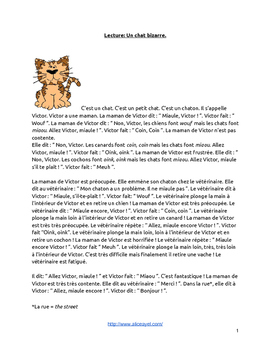
As a home practice, my learners can read the story again and listen to it being told in the gorgeous Quebec accent! I have also written a parallel story with a kitten called Victor. You can purchase the reading activity along with comprehension questions, a grammar/vocabulary part to find out about animals (adults and babies) and to reinforce the verb ” faire ” in the present tense, a creative writing to use the key structures and finally a teacher corner with more links and tips to extra activities and ideas: videos, flashcards… on my Teachers Pay Teachers store.
What about you? Are you reading children’s stories to your learners? Do you hold “Kindergarten days”? I would be interested to find out about your own experiences!