Dear French Story Listeners,
There is something about November. The light fades early, the rain taps at the window, and a good book feels like the best company in the world.
The learner’s dilemma
If you’re learning French, you may have noticed that most books for learners fall into one of two traps.
Some are too simple: short, babyish stories that Charlotte Mason would have called twaddle. They talk down to the reader and leave nothing behind.
Others are wonderful stories that are simply too hard, because they need vocabulary and structures you haven’t absorbed yet.

What you need is in between. You need a living book.
What is a living book?
Charlotte Mason (1842–1923) was a British educator whose books still guide homeschooling families around the world.
She believed the mind feeds on ideas, as the body feeds on food.
Ideas travel best from one mind to another through books written by someone who loves the subject.

She called these living books: vivid, personal and respectful of the reader.
Their opposite is twaddle, writing so watered down that it talks down to you and leaves you hungry.
She insisted on living books because we remember what moves us.
A story that touches your heart stays with you, and so does the language it was told in.
A bag of marbles
This autumn, while choosing a book for Andy, one of my weekly coaching students, I came back to Un sac de billes by Joseph Joffo.
It’s the true story of two brothers, Joseph and Maurice, crossing occupied France alone.
It’s told with humour, tenderness and courage, through a child’s eyes, and in language simple enough to follow.
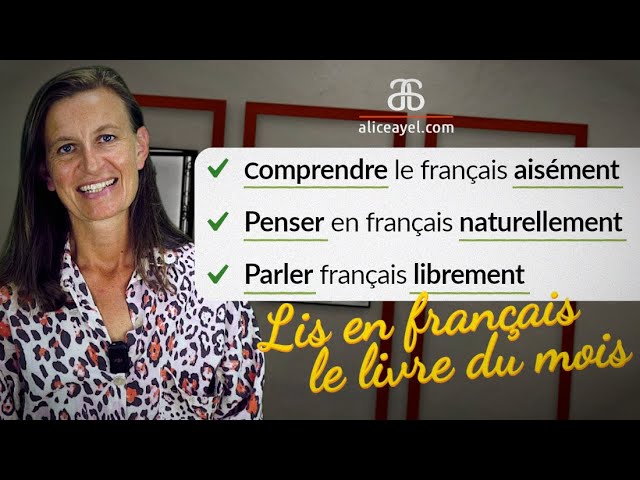
👉 Meet Joseph Joffo and his story in this week’s free video
It’s exactly what Charlotte Mason called a living book.
It isn’t a dry history lesson.
It’s one real person telling his own story so simply and vividly that the ideas come alive and stay with you.
That’s why it makes such a perfect first novel in French.
Simple tip: read for the story, not for every word
When you open a French book, you don’t need to understand every word.
If you know who is there, where they’re going and how they feel, then you’re reading.
Resist the urge to stop at each unknown word and reach for the dictionary.
Let the story carry you, and trust that your mind is quietly picking up the language as you go.
Each word you meet again in a new scene becomes a little clearer, and the more you read, the more there is to recognise.

Be gentle with yourself. You’ve got this.
À la semaine prochaine,
Alice 💕
P.S. Would you like me to find your right book and walk through it with you, chapter by chapter? That’s what I do with Andy each week in my Premium Coaching. Reply to this email and we’ll see if it’s a good fit for you. 💕