French news: embracing the silent phase
Coucou les membres de la communauté,
Last week, I shared with you my evolving perspective on pronunciation in French, emphasizing the importance of training our mouths and tongues to speak with confidence. (In case you missed it, read about my recent ephihany here!)
However, amidst this discussion, I feel that I need to reaffirm the significance of what is often referred to as the “silent phase” in language acquisition. In fact, Jeanne, my 4-year-old daughter, went through this phase before she started to mimic Portuguese sounds and practice speaking.

The silent phase is a crucial stage where you absorb and internalize the language without necessarily speaking it aloud. During this period, your focus shifts towards actively listening, observing, and understanding the language in context.
While it may seem counterintuitive, this phase lays the foundation for spontaneous and fluid speech later on.
Respecting the silent phase allows you to familiarize yourself with the sounds, rhythms, and structures of French, leading to a more natural and intuitive grasp of the language. You develop a strong mental framework, enabling you to express yourself confidently and authentically when you eventually begin speaking.
The duration of the silent phase varies from person to person, depending on their prior language learning experience and own personality (whether they are intro- or extro-vert). Some of you may progress more quickly through this phase, while others may require more time to feel comfortable expressing themselves orally.

As you continue on your French journey, remember that speaking French should ultimately come naturally, without any undue pressure or stress.
Understand with ease. Think naturally. Speak freely.
So when you watch my pronounciation videos, you do not have to repeat after me if you don’t feel like it yet.
- Oberve my facial expressions, my mouth, my eyes, my hand gestures.
- Actively listen to the sounds I am making.
- Make sense of what I am saying.
By doing this, you are devloping a strong mental framework.

Watch all my pronounciation videos here.
Our live sessions this week offer a supportive and encouraging environment where you can interact in French at your own pace. You can also choose to just actively listen to me live. When you don’t understand something, you can ask me directly.
Each session is limited to a small number of participants so that everyone can interact freely. Here are the remaining spots available this week:
– 3 spots left on Wednesday for beginners or advanced beginners who want to better grasp the verb – avoir -.
We will co-create a story together. Imagining a story in French helps you retain new vocabulary efficiently by embedding words within meaningful contexts.
– 2 spots left on Friday for intermediate learners who want to talk spontaneously about the weather.
We’ll be looking at idiomatic expressions, playing a guessing game (you will acquire lots of new words), and singing a song. Explore French culture in a relaxed environment!
Grab this opportunity : YOU’re part of a community that celebrates progress and growth.
Click here to reserve your spot now.
Cordialement,
P.S. Got friends, family, colleagues and clients who want to become fluent in French? Share this with them, they’ll thank you for it!
French news: train your mouth, tongue and tone of voice!
Coucou les membres de la communauté,
I want to share a personal revelation I’ve had regarding the role of pronunciation in language acquisition.
In the past, I held a strong belief that listening and reading were sufficient for language acquisition. While I still believe that comprehensible input is crucial for retaining vocabulary and structures, my perspective has evolved.
I’ve changed my mind because I observed Jeanne, my 4-year-old daughter, who is acquiring Portuguese at school.
I’ve noticed that in addition to listening and absorbing the Portuguese language, Jeanne actively trains her mouth, tongue muscles, and tone of voice to speak Portuguese. Even though some of her utterances do not make sense, they sound distinctly Portuguese.
As I watch my daughter effortlessly mimic Portuguese sounds and practice speaking in a relaxed environment (no pressure to speak correctly, of course!), I’ve come to realize the significance of training mouth and tongue muscles, as well as tone of voice, in language acquisition.

The act of producing sounds helps solidify
your grasp of the language.
With this new perspective, I’ve incorporated regular pronunciation trainings into our live sessions. We start each session with a warm-up where we focus on French sounds and sentences in a relaxed and supportive atmosphere. You have the option to stay muted on Zoom during this time (no pressure to speak in front of others, of course!).
You can also watch the warm-ups later on our members’ site.
By incorporating pronunciation warm ups, you accelerate your progress in French and you develop a more natural and confident speaking ability.
If you haven’t already, I encourage you to sign up for our live sessions this week.
Each session is limited to a small number of participants so that everyone can interact freely. Here are the remaining spots available this week:
– 4 spots left on Wednesday for beginners or advanced beginners who want to use the question what? We’ll be watching a cute short animation together and commenting on it
– 6 spots left on Friday for intermediate learners who want to talk spontaneously about what made them happy this week.
Whether you’re looking to improve your conversational French, gain confidence in French, or simply connect with fellow learners, our live sessions offer the perfect opportunity to do so.
Don’t miss out on this chance to make real progress!
Click here to reserve your spot now.
Stay motivated, and I look forward to seeing you in our upcoming sessions!
Understand with ease. Think naturally. Speak freely.
Cordialement,
P.S. Got friends, family, colleagues and clients who want to become fluent in French? Share this with them, they’ll thank you for it!
French news: last chance to join our live French sessions this week!
Coucou les membres de la communauté,
I hope this email finds you well and eager to continue your French journey!
I am excited to invite you to join our upcoming 45-minute live sessions happening this week.
But hurry – there are only a few spots left, so reserve yours today!
Here is why you should join my live sessions:
- Direct feedback from me. You have a question about something you don’t understand, ask me dircetly!
- Opportunities to speak French freely and with confidence. You will improve your French.
- A supportive environment where you speak French without fear. You’ll connect and make new friends from around the world.

Each session is limited to a small number of participants so that everyone can interact freely. Here are the remaining spots available this week:
– Only a few spots left on Wednesday for beginners or advanced beginners who want to express an opinion in French. We will have fun looking at entertaining pictures and giving our thoughts on them.
– One spot left on Friday for intermediate learners who want to talk spontaneously about their day. We will share what our typical day looks like!
Whether you’re looking to improve your conversational French, gain confidence in French, or simply connect with fellow learners, our live sessions offer the perfect opportunity to do so.
Don’t miss out on this chance to make real progress!
Click here to reserve your spot now.
I look forward to seeing you there!
New Senior Stage sessions!
I’m thrilled to announce 3 new sessions tailored for advanced learners seeking a deeper understanding of French grammar and literature.

Each session includes comprehensive video tutorials, detailed transcripts, audio recordings, and a comprehensive glossary.
In these sessions, you will gain insights into the usage of pronouns and their significance within the French language. You’ll also get to discover the very special friendship between Montaigne and de La Boétie.
Understand with ease. Think naturally. Speak freely.
Cordialement,
P.S. Got friends, family, colleagues and clients who want to become fluent in French? Share this with them, they’ll thank you for it!
French news: live sessions exclusive for our members
Coucou les membres de la communauté,
I’m thrilled to announce the launch of our weekly group sessions on Zoom. They are starting in May (next week already!).
Our live sessions are designed to keep you motivated, accountable, and consistently progressing in your French journey.
In these 45-minute sessions, you have the opportunity to engage with me and fellow members in a supportive and dynamic virtual environment. It is a collaborative and fun way to boost your French proficiency.
Here’s what you can expect from our group sessions:
- Weekly accountability: Stay on track with your French goals and make real progress.
- Engaging conversations tailored to your level. Understand with ease and speak French freely without fear.
- Feedback and guidance: Receive personalized feedback and guidance directly from me to address any challenges and maximize your progress.

How dos it work? Go to this page, click here!
- Choose & Book your Zoom session.
- You will receive an email from me with the Zoom link and password to access the session.
Stay on track. Ask me questions. Get feedback.
I can’t wait to help you move forward in your French journey!
Cordialement,
P.S. Got friends, family, colleagues and clients who want to become fluent in French? Share this with them, they’ll thank you for it!
Agen Takeaway #4: Reading
” Reading is breathing and comprehensible texts are oxygen” as Martina Bex wrote in a great article about reading in class.

At #Agen2019, I attended another inspiring session by the amazing Alina Filipescu about Free Voluntary Reading (Alina also happens to be one of my French online learners , she is my favourite one 😉
What is FVR?
“Free Voluntary Reading [FVR] means reading what you want to read, with no book reports, no questions at the end of the chapter, and not having to finish the book if you don’t want to. Sustained silent reading provides children with an opportunity to do free voluntary reading in school.” Stephen D. Krashen
This is the opening of Alina’s thoughtful blog post about how she has been building a FVR/SSR program with her Spanish classes.
This is also what Alina explained during her plenary presentation in Agen. The KEY is not to have reading as a dreading activity BUT at the same time holding students accountable for what they do.
How to get students to read for pleasure?
How to achieve it? Alina suggested different components such as:
- Sharing quotes about the positive impacts of reading. When I was teaching Spanish at Thuringia International School in Germany, I had posters in my classroom and in the school library about reading. I got most of them from Bryce Hedstrom website. It has an extensive list of reading “quotes”.
- Model pleasure reading during Sustained Silent reading (SSR). When my IB students were reading Spanish books, I would also read a German reader. Since most of my students were German, I would often ask them what a word meant in the book I was reading. That way, they knew they could also ask me or others in the class if they didn’t understand something about what they were reading. It made them feel comfortable about reading.
- Help students find the right book. The first books your students read should be easy to read with 150 to 200 unique words at most. Although my students were in grade 11 and 12 at an IB level (intermediate level), I first recommended them to read such “easy” books to start with. They realized reading in Spanish was not that difficult, they enjoyed the stories because they could understand them, they gained confidence. They thought: ” Wow! I can read a book in Spanish!” and they wanted to read more. This combined with Story Listening made my students read many books of around 400 unique words and more.
- Have students review the books they have read for the others. Alina showed how her students write a few things on a sticky note about the book and leave that on the cover when done. They can write if they liked the book (or not) and why OR they just draw how many stars (1-5) they would give the book. My students also did it and it was a great motivator for other students to read.
They also had a log book where they wrote how many pages or chapters they read during a lesson. They also wrote some new words if they wanted to or some expressions they liked. That way, they were keeping track of their progress throughout the year. - Have a ROUTINE. My routine was and still is (with my online learners) to read every lesson or at least once a week ( if I don’t see my learners regularly). Reading is POWERFUL and the MORE your students READ, the MORE they will acquire the language.
En pratique
As Alina explained, you cannot have your students read a book in silence for 10 minutes from day 1. You need to prepare them, to lead them the way.
To me, Story Listening is the bridge to Free Voluntary reading. And here are the steps I follow to lead learners to read independently:
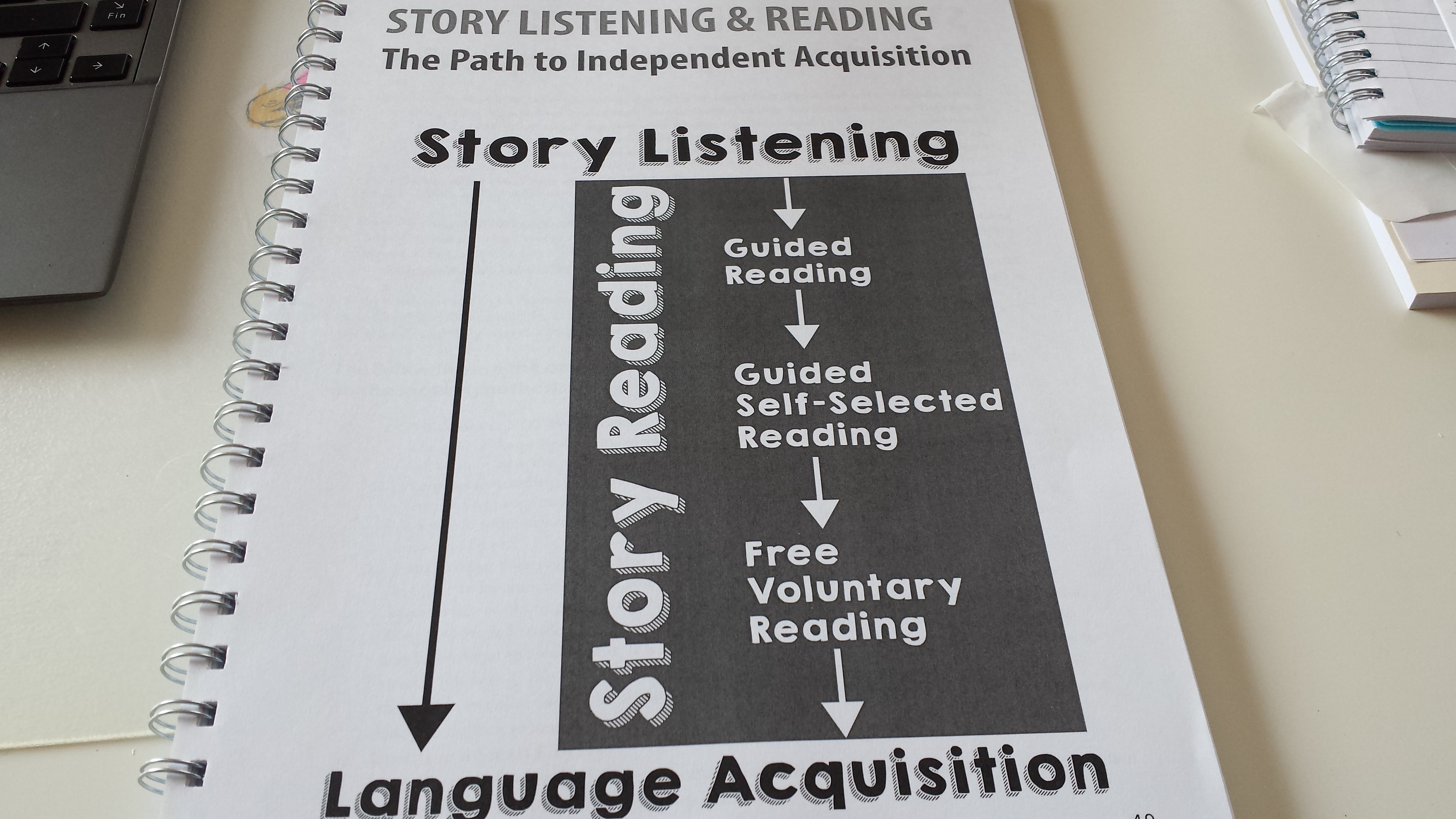
Story Listening enables students to hear French (or another language) and understand stories in French with the help of many different kinds of support. French is a difficult language to hear because the spelling doesn’t match the pronunciation, therefore Story Listening helps prepare to read as you write down words on the board and pronounce them at the same time.
Story Reading is introduced gradually and gently, using texts of high interest,so that students find the reading comprehensible and enjoyable. The goal is to establish a pleasure reading habit. Cécile Lainé wrote an excellent blog post about how to create enjoyable reading habits: Reading is fun, right?
What I do is I tell a story, then read it aloud to students. I also tell a story, then the students read a parallel story. For example with beginner learners, I would tell Des frites ! (which is actually based upon the children’s book by Stephanie Blake entitled ” Je veux des pâtes “).
Then students read and listen to a similar story (available when you are a member on my site) which you can download now: Paul veut manger des pizzas !
I am now building a database of such stories from beginner to advanced levels on the membership site. More stories (as well as articles, biographies and poems) are added every week. They all come with audio so learners can listen to how the words are pronounced. They get used to reading in French fluently.
Guided self-selected reading is when you go to the library with your students and help them choose a “real” book. You might sit next to them and read the book with them to see if it is right for them (and also to get them started!). Cécile Lainé wrote another great blog post about reaching this stage: Toward self selected reading.
Free Voluntary Reading is the ultimate stage when learners have become AUTONOMOUS. They have reached an intermediate level and they can choose a book on their own and read them with joy!
What about you? What are you strategies to get your students to read?
P.S. The eBook (pdf) about the adventures of Marie et Médor avant Noël is now available: 24 scripts in the present and in the past tense, and there is an eBook for dyslexic learners too.
For as little as 4.75EUR/month, you can download all the eBooks AND you have access to many other French stories, biographies, poems and articles (with a Dyslexic mode) as well as the audio files. JOIN NOW!
Read about Agen Takeway #1: Very Narrow Listening
Read about Agen Takeway #2: Get to know your learners
Read about Agen Takeway #3: Story Listening